What Does "FIT", "FICA", and "YTD" Mean on a Pay Stub?
What Does “FIT,” “FICA,” and “YTD” Mean on a Pay Stub? (2026) | ADP Salary Calculator
Pay Stub Glossary · Updated August 2026
What Does “FIT,” “FICA,” and “YTD” Mean on a Pay Stub?The Three Abbreviations You’ll See on Almost Every Paycheck
These three codes appear on nearly every pay stub in the country — here’s exactly what each one stands for and what it’s telling you.
📅 August 2026⏱ 6 min read🌐 adpsalarycalculator.com
⚡ Quick Answers
FIT
Federal Income Tax
FICA
Social Security + Medicare (7.65%)
YTD
Year-to-Date running total
If you’ve ever squinted at your pay stub trying to figure out what “FIT,” “FICA,” or “YTD” actually means, you’re far from alone — these three abbreviations show up on nearly every pay stub in the country, but almost nothing on the stub itself explains them.
Here’s the short version: FIT is your federal income tax, FICA is your Social Security and Medicare tax combined, and YTD just means “this year so far” next to whatever number it’s attached to. Below is the fuller explanation of each, plus a worked example showing all three together on one paycheck.
The amount withheld from this paycheck toward your federal income tax liability for the year. Unlike FICA, FIT is not a flat percentage — it’s calculated based on your income, your Form W-4 elections (filing status, dependents, other adjustments), and the federal tax brackets for the year.
This withholding is essentially a running estimate of what you’ll owe in federal tax for the year, spread across your paychecks. It’s reconciled when you file your tax return — if too much was withheld, you get a refund; if too little, you owe the difference.
You may also see this labeled as “FED,”“FWT” (Federal Withholding Tax), or simply “Federal” depending on your employer’s payroll setup. For a full walkthrough of how this figure is actually calculated, see our federal tax withholding guide.
2 Second Code
FICA — Social Security & Medicare
FICAFederal Insurance Contributions Act
FICA is actually two taxes bundled under one name: Social Security tax (6.2% of wages, up to the annual wage base) and Medicare tax (1.45% of all wages, no cap). Together, they total 7.65% of your gross wages, and your employer matches that amount separately.
Unlike FIT, FICA is a flat rate that applies the same way to nearly every employee regardless of filing status or W-4 elections — it funds Social Security retirement/disability benefits and Medicare hospital insurance specifically, not general government spending.
Some pay stubs show one combined “FICA” line; others break it into two separate lines: “SS” or “OASDI” for Social Security, and “MED” for Medicare. For the complete breakdown — including the Additional Medicare Tax for high earners — see our full FICA tax guide.
3 Third Code
YTD — Year-to-Date
YTDYear-to-Date
YTD isn’t a tax or a deduction at all — it’s a running total. Next to any figure on your pay stub (gross pay, FIT, FICA, a 401(k) contribution, and so on), a “YTD” column shows the cumulative amount from January 1 of the current calendar year through this specific pay period.
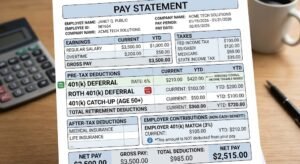
Most pay stubs show two columns for each line item: one for “This Period” (just this paycheck) and one for “YTD” (everything so far this year). This makes it easy to track progress toward things like annual retirement contribution limits without adding up every prior stub yourself.
YTD resets to zero at the start of each new calendar year. For more on how to use YTD figures — including spotting errors and estimating your annual tax picture — see our complete YTD guide.
4 Putting It Together
How the Three Relate to Each Other
FIT
FICA
YTD
What it is
A tax
A tax (two combined)
A running total, not a tax
Rate
Varies (10%–37% brackets)
Flat 7.65%
N/A
Appears next to
Its own line
Its own line(s)
Every line item on the stub
Resets when?
Recalculated each pay period based on income; annual liability resets each tax year
Recalculated each pay period; Social Security portion may stop once the wage cap is reached
Resets to $0 every January 1
In short: FIT and FICA are both things being taken out of your check, while YTD is a lens you can apply to almost any number on the stub — including FIT and FICA themselves — to see the year’s total so far.
5 Real Example
Real Example: All Three on One Pay Stub
Scenario: An employee earning $1,800 gross on a biweekly paycheck, six pay periods into the year (this is their 6th paycheck).
💰 Sample Pay Stub — This Period vs. YTD
Gross Pay (This Period)$1,800.00
Gross Pay (YTD)$10,800.00
FIT (This Period)−$162.00
FIT (YTD)−$972.00
FICA (This Period) — 7.65% of $1,800−$137.70
FICA (YTD)−$826.20
Net Pay (This Period)$1,500.30
Notice FICA (7.65%) is a consistent percentage of gross pay every period, while FIT is a smaller, differently-calculated amount based on the employee’s W-4 and tax bracket. The YTD columns simply add up six periods’ worth of each figure.
6 Nearby Codes
Other Common Codes You Might See Nearby
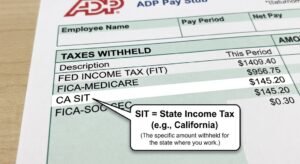
SIT / ST — State Income Tax
SS / OASDI — Social Security portion of FICA, shown separately
MED — Medicare portion of FICA, shown separately
SUI / SDI — State Unemployment or Disability Insurance (required in a handful of states)
LOC — Local or city income tax
YTD Net — Your cumulative take-home pay for the year, after all taxes and deductions
For the full list of deduction codes beyond taxes — retirement, health insurance, HSA/FSA, and more — see our payroll deductions guide.
7 Common Question
Why FIT and FICA Withholding Amounts Differ
It’s common to notice that FIT and FICA withholding rarely match, even on the same paycheck. That’s expected, not an error:
The Key Difference
FICA is a fixed 7.65% of nearly all your wages. FIT depends on your income level, filing status, and W-4 elections, and is calculated using progressive tax brackets — so it moves differently than FICA does as your pay changes.
A raise, a bonus, or a change to your W-4 can shift your FIT noticeably, while your FICA rate stays essentially fixed (aside from the Social Security wage cap late in the year for higher earners).
Frequently Asked Questions
FIT, FICA, and YTD — FAQs
What does FIT mean on a pay stub?
FIT stands for Federal Income Tax. It’s the amount withheld from your paycheck toward your federal income tax liability, based on your Form W-4 elections, filing status, and income.
What does FICA mean on a pay stub?
FICA stands for the Federal Insurance Contributions Act. It refers to the combined 7.65% deduction that funds Social Security (6.2%) and Medicare (1.45%). It may appear as one combined “FICA” line or as two separate lines labeled “SS” and “MED.”
What does YTD mean on a pay stub?
YTD stands for Year-to-Date. It shows the cumulative total of a given figure — such as gross pay, a specific tax, or a deduction — from January 1 of the current year through the current pay period, rather than just the amount for that single paycheck.
Are FIT and FICA the same thing?
No. FIT is federal income tax, which varies based on your income, filing status, and W-4 elections. FICA is a separate, flat-rate tax that specifically funds Social Security and Medicare, and applies at the same 7.65% rate for nearly all employees regardless of filing status.
Why is my FIT withholding different from my FICA withholding even though my gross pay is the same?
FIT is calculated using tax brackets and your W-4 elections, so it can vary significantly based on income level and filing status. FICA is a flat 7.65% (6.2% Social Security plus 1.45% Medicare) applied consistently to nearly all wages, which is why the two amounts rarely match even on the same paycheck.
Is YTD the same on every pay stub I get during the year?
No — YTD figures grow with each pay period, since they’re a running cumulative total. Your first pay stub of the year will show YTD figures equal to that period’s amount; your last pay stub of the year will show the full annual total for each line item.
See Your FIT and FICA Estimated Instantly
Enter your gross pay and filing details into our free ADP Salary Calculator to see estimated FIT, FICA, and net pay for any pay period.
Gusto vs Adp for Small Business ADP vs. Gusto Payroll for Small Business (2026 Comparison) | ADP Salary Calculator Payroll Software Comparison · Updated August