
What is FICA OASDI on My Paycheck?
What is FICA OASDI on My Paycheck What Is FICA OASDI on My Paycheck? (2026 Guide) | ADP Salary Calculator Pay Stub Glossary · Updated
Your pay stub is full of abbreviations and codes that rarely explain themselves. Here’s a plain-English breakdown of every common deduction — and why it’s coming out of your check.
Open any pay stub and you’ll see gross pay at the top, net pay (your actual deposit) at the bottom, and a list of line items in between that quietly explain the gap. Some of those lines — like federal tax and FICA — apply to nearly everyone. Others only show up if you’ve elected a specific benefit, like a 401(k) or health insurance plan.
This guide walks through every common deduction category you’re likely to see on an ADP pay stub, what it funds, and whether it’s calculated before or after taxes. For a full walkthrough of pay stub layout itself — gross pay, net pay, and YTD totals — see our guide to reading your ADP pay stub.
Before going line by line, it helps to understand the one distinction that explains almost everything else on your pay stub: whether a deduction is taken before or after taxes are calculated.
| Pre-Tax Deductions | Post-Tax Deductions | |
|---|---|---|
| When it’s taken | Before taxes are calculated | After taxes are calculated |
| Effect on taxable income | Lowers it | No effect |
| Common examples | Traditional 401(k), health insurance premiums, HSA, traditional FSA | Roth 401(k), garnishments, union dues (in some states), after-tax life insurance |
A pre-tax deduction reduces the income your federal (and often state) tax is calculated on, which is why increasing a pre-tax 401(k) contribution often shrinks your paycheck by less than the dollar amount you added.
These apply to virtually every paycheck, regardless of any elections you’ve made:
Withheld based on your Form W-4 elections, your filing status, and your income. This is an estimate of your annual tax liability spread across your paychecks — reconciled when you file your tax return. See our federal withholding guide for how this is calculated.
6.2% of gross wages up to the annual Social Security wage base ($184,500 in 2026), funding retirement, disability, and survivor benefits.
1.45% of all gross wages with no cap, funding Medicare hospital insurance. High earners pay an additional 0.9% above $200,000 in annual wages. See our FICA tax guide for the full breakdown.
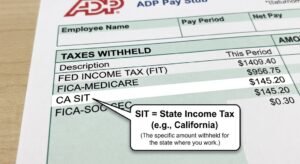
Applies in most states, calculated similarly to federal tax but using your state’s own brackets or flat rate. Nine states have no state income tax at all.
A small number of states (including California, New Jersey, and New York) require an employee-paid contribution toward state disability insurance or unemployment insurance, in addition to the employer-paid portion.
Some cities and counties (such as New York City, Philadelphia, and various Ohio municipalities) levy their own local income tax, withheld in addition to state and federal tax.
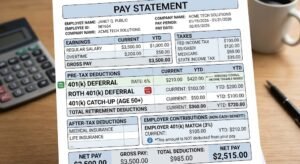
A percentage or flat dollar amount of your pay directed into your employer-sponsored retirement plan, reducing your taxable income for the year. The 2026 employee contribution limit is $24,500, or $32,500 if you’re 50 or older.
Similar to a traditional 401(k), but contributions are taxed now so qualified withdrawals in retirement are tax-free. Shares the same overall annual limit as traditional 401(k) contributions.
Some pay stubs display the employer’s matching contribution as a line item for transparency, even though it’s not actually deducted from your pay — it’s an employer contribution shown alongside your own.
Retirement plans similar to a 401(k) but used by nonprofit, educational, and certain government employers. Subject to the same general contribution limits as 401(k) plans in 2026.
Your share of the monthly premium for employer-sponsored health coverage, typically split into per-paycheck installments and usually deducted pre-tax under an IRS Section 125 cafeteria plan.
Similar to medical premiums, these are your share of the cost for optional dental or vision coverage, if elected during open enrollment.
Abbreviations indicating who’s covered under your plan — Employee Only, Employee + Spouse, Employee + Child(ren), or Employee + Family — which determines your premium amount.
Available if you’re enrolled in a qualifying high-deductible health plan. Funds roll over year to year and can be invested. The 2026 contribution limit is $4,400 for self-only coverage or $8,750 for family coverage, plus a $1,000 catch-up if you’re 55 or older.
Set-aside funds for eligible medical expenses, elected annually during open enrollment. Unlike an HSA, most FSA funds must be used within the plan year or a short grace period, though some plans allow a limited carryover (up to $680 in 2026). The 2026 contribution limit is $3,400.
A separate pre-tax account specifically for eligible child care or dependent care expenses, with its own annual limit set independently from the health care FSA.
Premiums for supplemental or voluntary life insurance beyond any basic coverage your employer provides for free. Employer-paid coverage above $50,000 in value can also create a small imputed income line (see below).
Voluntary income-replacement insurance in case of illness or injury. Paying premiums post-tax (rather than pre-tax) generally means any future benefit payout is received tax-free.
Under IRS rules, the value of employer-paid life insurance coverage above $50,000 counts as taxable income to you, even though you never receive it as cash. This can appear as an “addition” line rather than a subtraction.
These are deductions your employer is legally required to withhold, regardless of your own preference:
Withheld under a court or state child support agency order. Federal law caps how much of your disposable earnings can be garnished for this purpose, though the exact percentage depends on your situation.
A court-ordered deduction to satisfy a debt, such as unpaid taxes, defaulted student loans, or a creditor judgment. Employers are legally obligated to comply once they receive a valid garnishment order.
Membership dues withheld on behalf of a labor union, applicable only if you’re a union member at a unionized workplace.
Pre-tax set-asides for eligible parking or mass transit costs, subject to a monthly IRS limit that’s adjusted annually.
Repayment installments for an advance or loan your employer extended to you, such as a 401(k) plan loan or a company-specific advance.
Voluntary payroll-deducted donations to a charity or workplace giving campaign that you’ve opted into.
Scenario: An employee earning $2,400 gross per biweekly paycheck, contributing 5% to a traditional 401(k), enrolled in employer health insurance, and contributing to an HSA.
Notice that FICA (Social Security and Medicare) is calculated on a slightly different wage base than income tax. The health insurance premium and HSA contribution reduce wages for both income tax and FICA, since they’re withheld under a Section 125 cafeteria plan — but the traditional 401(k) contribution only reduces wages for income tax, not FICA. That’s why the two “taxable wages” figures above differ by exactly the $120 401(k) contribution.
Payroll systems like ADP process deductions in a specific sequence because each stage changes the base the next calculation is applied to:
ADP pay stub layouts vary by employer, since companies can customize deduction names and codes within the system. A few tips for decoding unfamiliar abbreviations:
Model pre-tax and post-tax deductions against your gross pay to see your exact estimated net pay with our free ADP Salary Calculator.
Try the Free Calculator →What is FICA OASDI on My Paycheck What Is FICA OASDI on My Paycheck? (2026 Guide) | ADP Salary Calculator Pay Stub Glossary · Updated
Why Is My ADP Check Pending? Why Is My ADP Check Pending? (2026 Guide) | ADP Salary Calculator Payroll Guide · Updated August 2026 Why

What Does OT Mean on an ADP Pay Stub? What Does “OT” Mean on an ADP Pay Stub? (2026 Guide) | ADP Salary Calculator Pay
What Does SIT Mean on an ADP Pay Stub? What Does “SIT” Mean on an ADP Pay Stub? (2026 Guide) | ADP Salary Calculator Pay

Gusto vs Adp for Small Business ADP vs. Gusto Payroll for Small Business (2026 Comparison) | ADP Salary Calculator Payroll Software Comparison · Updated August
How 401(k) Contributions Appear on a Pay Stub How 401(k) Contributions Appear on a Pay Stub (2026 Guide) | ADP Salary Calculator Retirement & Payroll
Estimate your net pay with this easy-to-use salary paycheck calculator.
Note: adpsalarycalculator.com is not affiliated with ADP, Inc. | For informational purposes only.
Copyright © 2026. All Rights Reserved.