
What is FICA OASDI on My Paycheck?
What is FICA OASDI on My Paycheck What Is FICA OASDI on My Paycheck? (2026 Guide) | ADP Salary Calculator Pay Stub Glossary · Updated
If you’ve spotted “SIT” on your pay stub and wondered what it’s paying for — or why it’s missing entirely — here’s the full explanation.
On an ADP pay stub, SIT stands for State Income Tax (sometimes also labeled SWT for State Withholding Tax, or Res. SIT for resident state income tax). It’s the mandatory amount your employer deducts from your gross pay and sends to your state’s tax department on your behalf.
Unlike some deductions, SIT isn’t optional — with narrow exceptions covered below, you can’t choose to skip it. This guide covers where it comes from, why some pay stubs don’t have it at all, and how to check that the amount looks right. For the rest of your pay stub’s tax lines, see our FIT, FICA, and YTD glossary.
State income tax (SIT) is a direct tax levied by individual states on income earned by their residents, and often by nonresidents who earn income sourced within that state. Like federal income tax, it’s a self-assessed tax — you technically owe it based on your annual return — but your employer withholds an estimate of it from each paycheck throughout the year so you’re not stuck with the full amount due at once.
Your SIT is generally determined by the state where you live or work, not necessarily where your employer’s headquarters is located. On your pay stub, it often appears with a two-letter state prefix or suffix code — for example, “CA SIT” for California or “NY SIT” for New York — so you can quickly identify which state’s tax is being withheld.
Not every state taxes wage income. If you live and work exclusively in one of these states, your SIT deduction will be zero or simply absent from your pay stub entirely:
| State | Wage Income Tax Status |
|---|---|
| Alaska | No state income tax |
| Florida | No state income tax |
| Nevada | No state income tax |
| New Hampshire | No tax on wage income |
| South Dakota | No state income tax |
| Tennessee | No state income tax |
| Texas | No state income tax |
| Washington | No tax on wages (taxes only certain capital gains) |
| Wyoming | No state income tax |
Every other state, plus the District of Columbia, withholds SIT from wages in some form — whether a flat rate or a progressive bracket system.
The amount withheld depends on two things: your gross earnings for the pay period, and the filing status, allowances, or exemptions you claimed on your state’s withholding form — a state-level equivalent of the federal Form W-4, sometimes with its own name (for example, California’s DE 4).
| Tax Structure | How It Works |
|---|---|
| Flat tax | One consistent percentage applies to all taxable income, regardless of how much you earn |
| Progressive tax | The tax rate increases as your income rises, similar in structure to the federal system |
Some states also offer reduced withholding for dependents, or state-specific tax credits similar to the federal Earned Income Tax Credit — if applicable, these are typically claimed on your state withholding form, the same way federal adjustments are claimed on your W-4.
These three abbreviations often appear near each other on a pay stub and are easy to mix up, but they fund different things:
| Abbreviation | Full Name | Who Pays It | What It Funds |
|---|---|---|---|
| SIT | State Income Tax | Employee (withheld from wages) | General state programs and services |
| SUI | State Unemployment Insurance | Usually the employer only (a few states also require an employee share) | Unemployment benefits for eligible workers who lose their job |
| SDI | State Disability Insurance | Employee, in states that have it (e.g., California, New York, New Jersey) | Short-term disability benefits for eligible workers |
If you see all three on the same pay stub, that’s expected in states like California — they’re separate line items funding separate programs, not duplicate charges.
Calculated using California’s progressive tax brackets, separate from federal tax and California SDI. Withheld funds are submitted to the California Franchise Tax Board.
Deducted to fund state-level public programs. If you live or work in New York City or Yonkers, you may see an additional local tax line alongside your state SIT.
If you live and work exclusively in Texas, you should not see an SIT deduction on your pay stub at all, since Texas doesn’t tax wage income.
If you live in one state but work in another, things can get more complex. Some neighboring states have reciprocity agreements, which exempt employees from paying income tax in both states — instead, only your resident state’s SIT is typically withheld.
In limited circumstances, yes. Your state withholding form provides instructions for claiming an SIT exemption — typically available if you had no state tax liability in the prior year and expect none in the current year, similar in concept to claiming “Exempt” on a federal W-4.
Scenario: An employee earning $2,200 gross on a biweekly paycheck, working in a state with a flat 4% state income tax rate.
In a progressive-tax state instead of a flat-tax state, this same employee’s SIT would be calculated using tiered brackets rather than one flat percentage — meaning the exact dollar amount would depend on where their income falls within that state’s specific bracket structure.
Estimate your take-home pay including state tax withholding with our free ADP Salary Calculator.
Try the Free Calculator →What is FICA OASDI on My Paycheck What Is FICA OASDI on My Paycheck? (2026 Guide) | ADP Salary Calculator Pay Stub Glossary · Updated
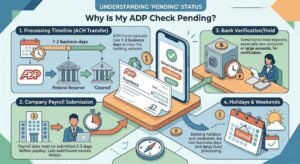
Why Is My ADP Check Pending? Why Is My ADP Check Pending? (2026 Guide) | ADP Salary Calculator Payroll Guide · Updated August 2026 Why

What Does OT Mean on an ADP Pay Stub? What Does “OT” Mean on an ADP Pay Stub? (2026 Guide) | ADP Salary Calculator Pay

Gusto vs Adp for Small Business ADP vs. Gusto Payroll for Small Business (2026 Comparison) | ADP Salary Calculator Payroll Software Comparison · Updated August
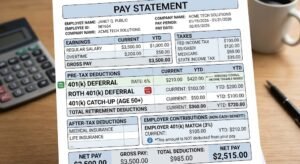
How 401(k) Contributions Appear on a Pay Stub How 401(k) Contributions Appear on a Pay Stub (2026 Guide) | ADP Salary Calculator Retirement & Payroll
Pay Stub vs Paycheck vs W-2: What’s the Difference? Pay Stub vs. Paycheck vs. W-2: What’s the Difference? (2026) | ADP Salary Calculator Payroll Glossary
Estimate your net pay with this easy-to-use salary paycheck calculator.
Note: adpsalarycalculator.com is not affiliated with ADP, Inc. | For informational purposes only.
Copyright © 2026. All Rights Reserved.