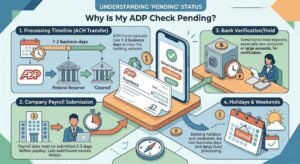
Why Is My ADP Check Pending?
Why Is My ADP Check Pending? Why Is My ADP Check Pending? (2026 Guide) | ADP Salary Calculator Payroll Guide · Updated August 2026 Why
If you’ve spotted “OASDI” or “Fed OASDI/EE” on your pay stub, here’s exactly what it is, what it costs you in 2026, and what you get for it down the road.
OASDI stands for Old-Age, Survivors, and Disability Insurance — the official government name for what almost everyone calls Social Security tax. If your pay stub shows a line labeled “OASDI,” “Fed OASDI/EE,” or simply “Social Security,” they’re all referring to the exact same 6.2% deduction.
OASDI is one of the two components that make up FICA (Federal Insurance Contributions Act) withholding — the other being Medicare tax. This guide explains what OASDI actually funds, how the 2026 rate and wage cap work, how it eventually turns into your own retirement benefit, and what to do if you think you’ve overpaid. For the full FICA picture including Medicare, see our complete FICA tax guide.
OASDI (Old-Age, Survivors, and Disability Insurance) is the federal Social Security program administered by the Social Security Administration (SSA). It provides three types of benefits:
The tax that funds this program is deducted directly from your paycheck, and it’s this deduction — not the broader program — that appears on your pay stub as “OASDI.”
These three terms are related but not interchangeable, and mixing them up is one of the most common sources of pay stub confusion:
| Term | What It Actually Is |
|---|---|
| FICA | The umbrella law (Federal Insurance Contributions Act) that authorizes both payroll taxes below |
| OASDI | One component of FICA — 6.2% — funding Social Security retirement, survivor, and disability benefits |
| Medicare (HI) | The other component of FICA — 1.45% — funding Medicare hospital insurance |
Together, OASDI and Medicare make up the full 7.65% FICA withholding you see on your paycheck. When people say “FICA tax,” they almost always mean the combination of these two; OASDI is specifically the larger, Social-Security-funding piece.
| Detail | 2026 Figure |
|---|---|
| Employee OASDI rate | 6.2% of wages |
| Employer OASDI rate | 6.2% (matched separately, not deducted from your pay) |
| Combined rate | 12.4% |
| Annual wage base (cap) | $184,500 |
| Maximum employee OASDI tax for the year | $11,439.00 |
The wage base rises most years to keep pace with national average wage growth — it was $176,100 in 2025 and $168,600 in 2024. Once your year-to-date wages from a single employer cross $184,500 in 2026, that employer stops withholding OASDI for the remainder of the calendar year.
OASDI typically shows up as its own line item, separate from Medicare, though the exact label depends on your employer’s payroll system. Common variations include:
Withheld OASDI contributions flow into two federal trust funds managed by the Social Security Administration:
| Trust Fund | Purpose |
|---|---|
| Old-Age and Survivors Insurance (OASI) | Retirement benefits for eligible retirees, and benefits for survivors of deceased insured workers |
| Disability Insurance (DI) | Benefits for insured workers unable to work due to a qualifying physical or mental disability |
It’s a pay-as-you-go system: the OASDI contributions withheld from your paycheck today largely fund benefits being paid to current retirees and beneficiaries, not a personal account set aside specifically for you. When you eventually claim benefits, they’ll be funded by workers contributing at that time.
Because OASDI is a flat 6.2% rate up to the wage cap, it’s straightforward to estimate at any income level — until you cross the $184,500 cap, at which point the tax stops growing even though income keeps rising. Here’s what that looks like in practice:
| Annual Wages | Annual OASDI Tax (6.2%) | Effective Rate on Total Income |
|---|---|---|
| $35,000 | $2,170.00 | 6.2% |
| $65,000 | $4,030.00 | 6.2% |
| $95,000 | $5,890.00 | 6.2% |
| $150,000 | $9,300.00 | 6.2% |
| $184,500 (the 2026 cap) | $11,439.00 | 6.2% |
| $250,000 | $11,439.00 (capped) | 4.58% |
| $500,000 | $11,439.00 (capped) | 2.29% |
OASDI is often described as a regressive tax for exactly this reason: everyone pays the same 6.2% rate up to the cap, but higher earners pay a shrinking effective rate on their total income once wages exceed $184,500, since no additional OASDI is owed on income above that threshold.
This is different from Medicare tax, which has no cap at all — Medicare’s 1.45% rate (plus an extra 0.9% above certain thresholds) applies to every dollar earned, no matter how high income goes. That structural difference is a common point of confusion, since people sometimes assume both halves of FICA work the same way.
Paying OASDI tax isn’t just an obligation — it’s what makes you eligible for your own future Social Security benefits, tracked through a system of work credits.
Earning enough work credits makes you eligible for OASDI retirement benefits, but the age at which you actually start claiming them significantly affects your monthly amount. The SSA calculates a baseline monthly benefit at your Full Retirement Age (FRA), and adjusts it up or down depending on when you actually file.
| Birth Year | Full Retirement Age |
|---|---|
| 1943–1954 | 66 |
| 1955 | 66 and 2 months |
| 1956 | 66 and 4 months |
| 1957 | 66 and 6 months |
| 1958 | 66 and 8 months |
| 1959 | 66 and 10 months |
| 1960 and later | 67 |
Since your future benefit is calculated from your lifetime OASDI-covered earnings, it’s worth periodically confirming the SSA has an accurate record of what you’ve actually earned and paid in.
If you’re self-employed, there’s no separate employer to split the 12.4% with — you pay the full amount yourself through SECA (Self-Employment Contributions Act) tax rather than FICA.
Self-employed individuals pay the full 12.4% OASDI rate on net self-employment earnings up to the same $184,500 wage base, but they can deduct half of that SECA tax when calculating adjusted gross income on their federal return — partially offsetting the higher upfront rate.
Exemptions are narrow, and most workers have no legal way to opt out. The recognized exceptions include:
If you’re a state or local government employee not covered by Social Security — meaning OASDI isn’t withheld from your public-sector paycheck — a major related rule changed recently. The Social Security Fairness Act, signed into law in January 2025, repealed two provisions called the Windfall Elimination Provision (WEP) and Government Pension Offset (GPO).
These provisions previously reduced Social Security benefits for people who received a government pension from non-OASDI-covered work but also qualified for Social Security benefits through other employment or a spouse. With WEP and GPO repealed, roughly 3.2 million affected teachers, police officers, firefighters, and other public employees are now eligible for higher monthly benefits, with retroactive payments back to January 2024 for those affected. If this applies to you and you never filed for a spousal or survivor benefit because GPO previously made it seem pointless, it’s worth checking with the SSA directly, since that benefit may now be available.
Unlike federal income tax, OASDI is not generally refundable — it’s an insurance contribution, not a pre-payment toward a return. But in one specific, common scenario, you actually can get money back.
If you work for two or more employers in the same calendar year, each employer withholds OASDI independently, without knowledge of what the others are withholding. If your combined wages across all employers exceed $184,500 in 2026, more than the maximum $11,439 may have been withheld in total.
It’s a fair question to ask, given how much of your paycheck goes toward OASDI every period: will the program still be there when it’s your turn to collect? The honest answer, based on the Social Security Trustees’ 2026 annual report, is more nuanced than headlines often suggest.
| Trust Fund | Projected Depletion | What Happens at Depletion |
|---|---|---|
| OASI (retirement/survivors, standalone) | Fourth quarter of 2032 | Able to pay about 78% of scheduled benefits from ongoing tax revenue |
| Combined OASDI (retirement + disability) | Third quarter of 2034 | Able to pay about 83% of scheduled benefits from ongoing tax revenue |
“Trust fund depletion” does not mean Social Security disappears or stops paying benefits entirely. It means the reserve fund runs out, and the program would then rely solely on ongoing OASDI tax revenue — which, under current projections, would still cover roughly 78–83% of scheduled benefits, not zero.
The two trust funds (OASI for retirement/survivors and DI for disability) are technically separate, though they’re often discussed together as “OASDI.” The disability fund alone is projected to remain solvent through the full 75-year projection window; it’s the retirement fund specifically driving the more urgent 2032 date.
None of this changes what’s withheld from your paycheck today — the 6.2% rate and $184,500 cap apply regardless of the program’s long-term financing outlook. Congress has addressed similar funding gaps before through legislative changes to the rate, the cap, the benefit formula, or some combination, and has years of lead time before the projected depletion dates arrive. Whether and how lawmakers act remains a live political question, not something reflected in your current withholding.
Scenario: An employee earning $95,000 annually, paid semimonthly (24 paychecks/year), so each gross paycheck is $3,958.33.
Since this employee’s annual wages ($95,000) stay well under the $184,500 wage base, OASDI is withheld consistently at 6.2% on every paycheck all year, totaling $5,890 in OASDI tax for the year — no mid-year cutoff applies at this income level.
They’re the exact same tax. OASDI is simply the official, technical name; “Social Security tax” is the common name. Your pay stub might use either label.
OASDI operates on a pay-as-you-go basis. Current contributions largely fund benefits for today’s retirees and beneficiaries — there’s no individual account holding your specific contributions, though your contribution history determines your own future benefit eligibility and amount.
Only OASDI has a wage cap. Medicare tax, the other half of FICA, applies to all wages with no cap, and high earners pay an additional 0.9% Medicare surtax above certain thresholds.
Under current projections, even after the combined trust fund is depleted in 2034, ongoing OASDI tax revenue would still cover roughly 83% of scheduled benefits — a reduction, not an elimination. The withholding on your paycheck today isn’t affected by this projection either way.
Enter your gross pay into our free ADP Salary Calculator to see your estimated OASDI, Medicare, and net pay for any pay period.
Try the Free Calculator →Why Is My ADP Check Pending? Why Is My ADP Check Pending? (2026 Guide) | ADP Salary Calculator Payroll Guide · Updated August 2026 Why

What Does OT Mean on an ADP Pay Stub? What Does “OT” Mean on an ADP Pay Stub? (2026 Guide) | ADP Salary Calculator Pay
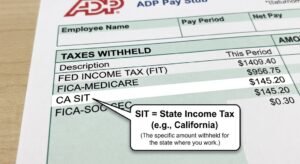
What Does SIT Mean on an ADP Pay Stub? What Does “SIT” Mean on an ADP Pay Stub? (2026 Guide) | ADP Salary Calculator Pay

Gusto vs Adp for Small Business ADP vs. Gusto Payroll for Small Business (2026 Comparison) | ADP Salary Calculator Payroll Software Comparison · Updated August
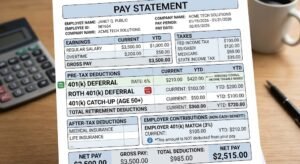
How 401(k) Contributions Appear on a Pay Stub How 401(k) Contributions Appear on a Pay Stub (2026 Guide) | ADP Salary Calculator Retirement & Payroll
Pay Stub vs Paycheck vs W-2: What’s the Difference? Pay Stub vs. Paycheck vs. W-2: What’s the Difference? (2026) | ADP Salary Calculator Payroll Glossary
Estimate your net pay with this easy-to-use salary paycheck calculator.
Note: adpsalarycalculator.com is not affiliated with ADP, Inc. | For informational purposes only.
Copyright © 2026. All Rights Reserved.