What Does “OT” Mean on an ADP Pay Stub? (2026 Guide) | ADP Salary Calculator
Pay Stub Glossary · Updated August 2026
What Does “OT” Mean on an ADP Pay Stub?Overtime, Explained Simply
A quick, clear explanation of the OT line on your pay stub — what it means, how it’s calculated, and how to spot it if something looks off.
📅 August 2026⏱ 6 min read🌐 adpsalarycalculator.com
⚡ Quick Answers
OT stands for
Overtime
Minimum federal rate
1.5× your regular rate
Kicks in after
40 hours in one workweek
Where it appears
Earnings section, with a YTD total
On an ADP pay stub, OT stands for Overtime — pay at 1.5 times your regular hourly rate for every hour worked beyond 40 in a single workweek. It’s required for non-exempt employees under the federal Fair Labor Standards Act (FLSA), and it’s one of the more closely watched lines on a pay stub, since it directly affects that period’s paycheck.
This guide covers the basics of what OT means, where it shows up, and how it’s calculated. For the full picture — weighted rates across multiple pay rates, bonus adjustments, and how the new 2026 overtime tax deduction is reported — see our in-depth overtime pay stub guide.
OT is short for Overtime — additional pay owed to non-exempt employees for hours worked beyond 40 in a single workweek. Under the FLSA, the minimum overtime rate is 1.5 times your regular hourly rate, commonly called “time and a half.”
Applies per workweek, not per pay period — a two-week pay period doesn’t average hours across both weeks
Employers can pay more than 1.5×, but never less
Some employers voluntarily pay double-time for holidays, though this isn’t federally required
2 Where to Find It
Where OT Appears on a Pay Stub
OT / OVTOvertime
Earnings Section
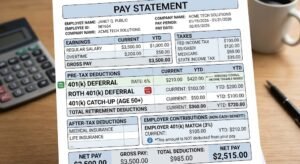
Typically shown as its own line in the earnings section, alongside “Regular” hours — listing the overtime hours worked and the overtime dollar amount earned for the current pay period, plus a Year-to-Date (YTD) running total.
Whether your pay stub is digital (through a portal like ADP’s) or paper, federal labor law requires overtime to be itemized and accurate — you’re entitled to review and verify this line the same way you would any other part of your pay.
Overtime must legally be calculated on your regular rate of pay — which can be higher than your stated hourly wage if you also receive:
Non-discretionary bonuses (announced in advance, tied to performance or attendance)
Shift differentials (extra pay for nights, weekends, or less desirable shifts)
Commissions
If any of these apply to you, your actual OT rate on the pay stub may be slightly higher than a simple hourly-rate-times-1.5 calculation — that’s expected, not an error. See our in-depth overtime guide for the full weighted-rate and bonus-adjustment math.
5 State Rules
State Rules Can Add More
Federal law sets the floor, but some states go further:
State
Additional Rule
California
Time-and-a-half after 8 hours in a single workday, and double-time after 12 hours in a day, regardless of the weekly total
Most other states
Follow the federal 40-hours-per-week standard with no additional daily threshold
6 Who Gets OT
Exempt vs. Non-Exempt
OT only applies to non-exempt employees — those legally entitled to overtime under the FLSA, typically hourly workers or lower-paid salaried employees. Exempt employees (salaried, meeting specific duties and minimum salary tests) don’t receive overtime pay regardless of hours worked, so they won’t see an OT line on their pay stub at all.
7 Worked Example
Worked Example
Scenario: A non-exempt employee earning $24/hour works 46 hours in one workweek — 40 regular, 6 overtime.
💰 Sample Pay Stub — OT Line
Regular (40 × $24.00)$960.00
OT rate ($24.00 × 1.5)$36.00/hr
OT (6 hrs × $36.00)$216.00
Total Gross Pay$1,176.00
8 Verification
Checking If Your OT Looks Right
Confirm your total hours worked for that specific workweek against your own timesheet
Check whether a bonus or shift differential that period should have raised your regular rate
Confirm your exempt/non-exempt classification hasn’t changed unexpectedly
If it still looks off, bring the specific pay period and your own hour count to your supervisor, HR, or payroll department
Frequently Asked Questions
OT on a Pay Stub — FAQs
What does OT stand for on a pay stub?
OT stands for Overtime — pay at 1.5 times your regular hourly rate for hours worked beyond 40 in a single workweek, as required by the Fair Labor Standards Act (FLSA) for non-exempt employees. It may also appear abbreviated as “OVT.”
Where does OT appear on a pay stub?
OT typically appears in the earnings section of a pay stub, alongside regular hours, as its own line showing the overtime hours worked and the overtime pay earned for the current period, along with a Year-to-Date (YTD) running total.
Why is my OT rate more than 1.5 times my hourly wage?
Overtime must be calculated on your “regular rate” of pay, which can include non-discretionary bonuses, shift differentials, and commissions in addition to your base hourly rate — not just your stated hourly wage. If you receive any of these, your true overtime rate can be higher than your hourly rate times 1.5.
Does every state calculate overtime the same way?
No. Federal law requires overtime after 40 hours in a workweek, but some states have additional rules — California, for example, requires time-and-a-half after 8 hours in a single workday and double-time after 12 hours, regardless of the weekly total.
Do salaried employees get OT on their pay stub?
Only if they’re classified as non-exempt. Salaried exempt employees, who meet specific duties and minimum salary tests under the FLSA, are not entitled to overtime pay and generally won’t see an OT line on their pay stub regardless of hours worked.
Is overtime taxed differently than regular pay?
No — overtime is taxed at the same federal and state income tax rates as your regular wages. There’s no special “overtime tax rate.” See our overtime tax guide for a full breakdown, including the new 2026 overtime tax deduction.
Estimate Your Overtime Take-Home Pay
See exactly how gross overtime pay turns into net pay after taxes with our free ADP Salary Calculator.
Gusto vs Adp for Small Business ADP vs. Gusto Payroll for Small Business (2026 Comparison) | ADP Salary Calculator Payroll Software Comparison · Updated August
Pay Stub vs Paycheck vs W-2: What’s the Difference? Pay Stub vs. Paycheck vs. W-2: What’s the Difference? (2026) | ADP Salary Calculator Payroll Glossary