
What is FICA OASDI on My Paycheck?
What is FICA OASDI on My Paycheck What Is FICA OASDI on My Paycheck? (2026 Guide) | ADP Salary Calculator Pay Stub Glossary · Updated
Confused by all those numbers and abbreviations on your ADP paycheck? This guide explains every single section in plain English — no accounting degree required.
Every payday, millions of American workers receive a pay stub through ADP — one of the country’s largest payroll providers. But most people glance at the bottom number (their take-home pay) and ignore everything else.
That’s a mistake. Your pay stub is a financial document packed with important information about your earnings, tax withholdings, benefits contributions, and year-to-date totals. Understanding it can help you catch payroll errors, plan your finances, and avoid a surprise tax bill.
This guide walks you through every section of an ADP pay stub, step by step.
The very top of your ADP pay stub contains basic identification details. This confirms the pay stub belongs to you and shows who issued it.
What you’ll see:
Just below your personal info, you’ll find two important dates that define when you worked and when you were paid.
| Field | What It Means |
|---|---|
| Pay Period | The date range you are being paid for (e.g., June 1–14, 2026) |
| Pay Date | The date money is deposited into your account or check is issued |
| Check Number | A unique reference number for this payment — keep for your records |
This is the most important part of your pay stub — it shows how much you earned before any deductions. Each type of pay appears as a separate line item.
| Earning Type | Description |
|---|---|
| Regular | Your base pay for standard hours worked during the pay period |
| Overtime (OT) | Pay at 1.5× your regular rate for hours beyond 40/week |
| Holiday Pay | Compensation for working on or receiving paid company holidays |
| Bonus | One-time or recurring performance-based additional pay |
| Commission | Earnings based on sales or performance targets |
| PTO / Vacation | Paid time off hours used during this pay period |
| Sick Pay | Paid sick leave hours used during this pay period |
Gross Pay = Total of ALL earnings before any taxes or deductions are taken out
This section shows all taxes withheld from your paycheck. These are mandatory — you cannot opt out of them.
| Tax | Rate / Details |
|---|---|
| Federal Income Tax | Based on your W-4 filing status. Ranges from 10%–37% depending on your taxable income bracket. |
| Social Security (OASDI) | 6.2% of wages up to $174,900 (2026 wage base). Your employer also pays 6.2% on your behalf. |
| Medicare (MED) | 1.45% of all wages. High earners above $200,000 pay an extra 0.9% Additional Medicare Tax. |
Pre-tax deductions are taken from your gross pay before taxes are calculated. This reduces your taxable income — meaning you pay less in taxes overall.
| Deduction | What It Is |
|---|---|
| 401(k) / 403(b) | Retirement savings. 2026 limit: $23,500/year ($31,000 if age 50+) |
| Health Insurance | Medical, dental, and vision premiums under your employer’s group plan |
| FSA | Flexible Spending Account — pre-tax funds for medical or dependent care costs |
| HSA | Health Savings Account — only available with a High Deductible Health Plan |
| Commuter Benefits | Pre-tax transit/parking benefits (up to $315/month in 2026) |
| Group Life Insurance | Employer-provided life insurance premiums (up to $50,000 coverage is pre-tax) |
Gross $4,000 − $200 (401k) − $150 (health) = $3,650 taxable. You save taxes on every single paycheck.
Post-tax deductions come out after taxes are calculated. They don’t lower your taxable income, but they may provide other long-term benefits.
Net Pay is the amount actually deposited into your bank account (or printed on your check). Here’s how it’s calculated:
On ADP stubs this is labeled “Net Pay”, “Net Check”, or “Amount Paid.”
If you have multiple bank accounts set up for direct deposit, ADP splits your net pay across them. Each deposit appears as a separate line with its own bank reference and amount.
On the right side of your ADP pay stub, every earnings and deduction item has a YTD column showing the running cumulative total from January 1 through your current pay date.
Many ADP pay stubs include a leave balance section at the bottom. This section varies significantly by employer — some companies don’t include it at all, or track leave in a separate HR portal.
Here are the most common abbreviations you’ll see on an ADP pay stub:
Payroll errors are more common than most people realize. Always check your pay stub for these issues:
Now that you understand your pay stub, use our free ADP Salary Calculator to estimate your net pay, see exactly how deductions affect your paycheck, and plan your finances with confidence.
Try the Free Calculator →What is FICA OASDI on My Paycheck What Is FICA OASDI on My Paycheck? (2026 Guide) | ADP Salary Calculator Pay Stub Glossary · Updated
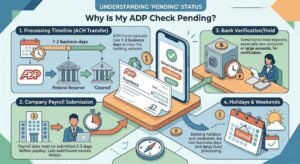
Why Is My ADP Check Pending? Why Is My ADP Check Pending? (2026 Guide) | ADP Salary Calculator Payroll Guide · Updated August 2026 Why

What Does OT Mean on an ADP Pay Stub? What Does “OT” Mean on an ADP Pay Stub? (2026 Guide) | ADP Salary Calculator Pay
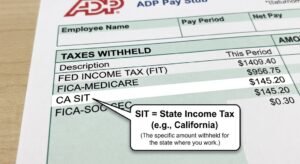
What Does SIT Mean on an ADP Pay Stub? What Does “SIT” Mean on an ADP Pay Stub? (2026 Guide) | ADP Salary Calculator Pay

Gusto vs Adp for Small Business ADP vs. Gusto Payroll for Small Business (2026 Comparison) | ADP Salary Calculator Payroll Software Comparison · Updated August
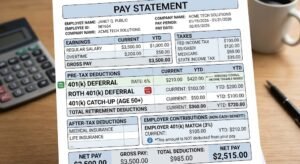
How 401(k) Contributions Appear on a Pay Stub How 401(k) Contributions Appear on a Pay Stub (2026 Guide) | ADP Salary Calculator Retirement & Payroll
Estimate your net pay with this easy-to-use salary paycheck calculator.
Note: adpsalarycalculator.com is not affiliated with ADP, Inc. | For informational purposes only.
Copyright © 2026. All Rights Reserved.