
What is FICA OASDI on My Paycheck?
What is FICA OASDI on My Paycheck What Is FICA OASDI on My Paycheck? (2026 Guide) | ADP Salary Calculator Pay Stub Glossary · Updated
Your overtime pay stub probably looks more detailed than it used to — and there’s a real reason why. Here’s what each overtime line means and why your rate isn’t always a simple 1.5×.
If your pay stub’s overtime section suddenly looks more detailed than you remember — more lines, an unfamiliar “weighted rate,” or a rate that doesn’t match a simple hourly-rate-times-1.5 calculation — you’re not imagining it. Payroll systems have genuinely added more detail to overtime reporting recently, partly due to a 2025 federal law change affecting how overtime is taxed and reported.
This guide breaks down exactly what each overtime line on your pay stub means, why your overtime rate can vary week to week, and how the new overtime tax deduction shows up on your paycheck and W-2. For the tax side of overtime — brackets, withholding, and take-home percentage — see our complete overtime tax guide.
Many employees assume overtime is simply their hourly rate multiplied by 1.5. In reality, federal law requires overtime to be calculated using your regular rate of pay for that workweek — which can be higher than your stated hourly wage if it includes:
If any of these apply to you, your true overtime rate will be somewhat higher than your base hourly rate × 1.5 — and that’s expected, not an error.
Modern payroll systems, including ADP, now break overtime into more distinct line items than older, simpler pay stubs did. Here’s what each commonly means:
Your calculated regular rate for that workweek, which forms the base that the 1.5× overtime multiplier is applied to. This can differ from your stated hourly wage if bonuses or shift differentials apply.
The additional half-time premium paid on top of your straight-time rate for overtime hours — the portion that makes time-and-a-half actually 1.5× instead of 1×. Often shown as a separate line from the straight-time portion of overtime hours.
A blended average rate used when you worked at more than one pay rate during the same workweek. Covered in detail below.
An extra payment reflecting the fact that a bonus paid during the period increased your regular rate, and therefore your overtime pay owed for hours already worked. Covered in detail below.
Some pay stubs separate weekly (FLSA) overtime from daily overtime required by certain state laws, or separate straight-time overtime from premium overtime, resulting in more than one overtime line for the same pay period.
Before adding complexity, it helps to see the simplest version of the calculation — no bonuses, no shift differentials, one job, one rate:
Federal law under the Fair Labor Standards Act (FLSA) requires this 1.5× rate for hours worked beyond 40 in a single workweek for non-exempt employees. Everything in the sections below explains what happens when your actual pay situation is more complex than this baseline case.
If you work more than one job, role, or shift at different pay rates for the same employer during a single workweek, your overtime rate isn’t calculated on just one of those rates — it’s a weighted average across all hours worked that week.
Scenario: An employee works 30 hours at $20/hour in one role and 15 hours at $26/hour in a second role during the same workweek — 45 total hours, 5 of them overtime.
Note that the $990 in straight-time earnings already includes pay for all 45 hours at their respective rates — the additional $55 is just the extra half-time premium owed on the 5 overtime hours, calculated using the blended rate.
If you receive a non-discretionary bonus during a pay period in which you also worked overtime, that bonus must be factored into your regular rate — which can trigger an additional “Bonus OT Adjustment” payment.
Scenario: An employee earning $20/hour works 45 hours in a week (5 overtime hours) and also receives a $100 production bonus for that same week.
This is why a bonus paid partway through a pay period sometimes generates a small, separate “true-up” payment on your pay stub — it’s the extra overtime premium the bonus itself triggered, not a payroll error.
Because your regular rate depends on that specific week’s pay mix, it’s normal for your effective overtime rate to shift from one pay period to the next based on:
A different overtime rate from one paycheck to the next doesn’t automatically indicate an error — it may correctly reflect that particular week’s blended regular rate.
A significant reason pay stubs and W-2 forms are changing is the One Big Beautiful Bill Act (OBBBA), signed into law in July 2025. It created a temporary federal income tax deduction for what the law calls “qualified overtime compensation.”
| Detail | 2025–2028 Rule |
|---|---|
| Deduction cap | $12,500 (single) / $25,000 (married filing jointly) |
| What qualifies | Only the FLSA-required premium (“half-time”) portion of overtime |
| Phase-out begins | $150,000 MAGI (single) / $300,000 MAGI (joint) |
| Excluded filing status | Married filing separately |
| Effective years | Tax years 2025 through 2028 |
| Who’s eligible | W-2 employees only, with a work-eligible Social Security number |
The deduction is claimed on your federal tax return, not applied automatically to your paycheck — though you can adjust your W-4 to reduce withholding in anticipation of it. This deduction doesn’t change how much overtime you’re paid; it only affects how much of that overtime is taxed at filing time.
Starting with tax year 2026, employers are required to separately report qualified overtime compensation on Form W-2.
Box 12, Code TT — the dollar amount of your qualified (FLSA-required) overtime premium for the year.
Because this only reflects the qualifying premium portion, it will typically be a smaller number than your total overtime earnings for the year — the straight-time portion of overtime hours, plus any non-qualifying overtime premiums, won’t appear in this box even though they were still part of your taxable wages in Box 1.
Everything above applies to non-exempt employees — those legally entitled to overtime pay under the FLSA. If you’re classified as exempt, none of this appears on your pay stub because you don’t receive overtime pay at all, regardless of hours worked.
| Non-Exempt | Exempt | |
|---|---|---|
| Entitled to overtime pay | Yes | No |
| Typical basis | Hourly, or salaried below the exemption threshold | Salaried, meeting duties + salary tests (executive, administrative, professional, etc.) |
| 2026 federal minimum salary threshold | N/A | $684/week federal minimum (some states set higher thresholds) |
Your classification is determined by your employer based on your job duties and salary level, not by your personal preference — and it should be reflected clearly, though not always by name, in your offer letter or HR records.
Federal law sets the floor — 1.5× after 40 hours in a workweek — but some states require overtime under additional circumstances:
Remember: the federal overtime tax deduction described above only covers the FLSA-required weekly premium — daily overtime required purely by state law is generally not “qualified overtime compensation” for the federal deduction, even though it’s still real, taxable overtime pay you’re owed.
Scenario: A non-exempt employee earning $24/hour works 46 hours in one workweek with no bonuses or shift differentials — the simplest realistic case.
On this employee’s W-2, the $72 OT Premium would be the portion reported under Box 12, Code TT as qualified overtime compensation, assuming it’s required under the FLSA and no phase-out applies — while the full $216 in overtime-hour pay ($144 + $72) is included in Box 1 taxable wages as usual.
See exactly how gross overtime pay turns into net pay after taxes with our free ADP Salary Calculator.
Try the Free Calculator →What is FICA OASDI on My Paycheck What Is FICA OASDI on My Paycheck? (2026 Guide) | ADP Salary Calculator Pay Stub Glossary · Updated
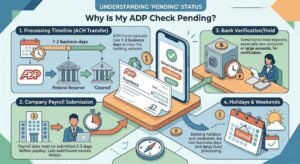
Why Is My ADP Check Pending? Why Is My ADP Check Pending? (2026 Guide) | ADP Salary Calculator Payroll Guide · Updated August 2026 Why

What Does OT Mean on an ADP Pay Stub? What Does “OT” Mean on an ADP Pay Stub? (2026 Guide) | ADP Salary Calculator Pay
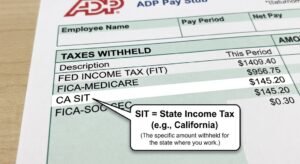
What Does SIT Mean on an ADP Pay Stub? What Does “SIT” Mean on an ADP Pay Stub? (2026 Guide) | ADP Salary Calculator Pay

Gusto vs Adp for Small Business ADP vs. Gusto Payroll for Small Business (2026 Comparison) | ADP Salary Calculator Payroll Software Comparison · Updated August
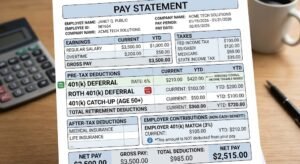
How 401(k) Contributions Appear on a Pay Stub How 401(k) Contributions Appear on a Pay Stub (2026 Guide) | ADP Salary Calculator Retirement & Payroll
Estimate your net pay with this easy-to-use salary paycheck calculator.
Note: adpsalarycalculator.com is not affiliated with ADP, Inc. | For informational purposes only.
Copyright © 2026. All Rights Reserved.