
What is FICA OASDI on My Paycheck?
What is FICA OASDI on My Paycheck What Is FICA OASDI on My Paycheck? (2026 Guide) | ADP Salary Calculator Pay Stub Glossary · Updated
Working overtime? Learn exactly how overtime pay is calculated, how it’s taxed, and how much you’ll actually take home — with real dollar examples for every scenario.
Overtime pay can significantly boost your paycheck — but many workers are confused about how it’s taxed. The most common misconception is that overtime is taxed at a higher rate than regular pay. It isn’t.
Overtime wages are subject to the exact same federal income tax brackets, Social Security, and Medicare taxes as your regular wages. What changes on a high-overtime paycheck is the withholding amount — which can look larger than usual — but your actual tax rate remains the same.
This guide walks through exactly how to calculate overtime pay, how each tax applies to it, and how much you’ll realistically take home after all deductions. For a full view of how taxes and deductions appear on your actual paycheck, see our complete guide to reading your ADP pay stub.
Overtime pay is additional compensation paid to eligible employees who work more than a set number of hours in a workweek. Under the federal Fair Labor Standards Act (FLSA), most hourly and non-exempt salaried employees must be paid at least 1.5 times their regular rate for every hour worked beyond 40 in a single workweek.
Calculating overtime gross pay is straightforward. Here are the formulas:
| Regular Rate | Overtime Rate (1.5×) | OT Pay for 5 hrs | OT Pay for 10 hrs | OT Pay for 20 hrs |
|---|---|---|---|---|
| $15.00/hr | $22.50/hr | $112.50 | $225.00 | $450.00 |
| $18.00/hr | $27.00/hr | $135.00 | $270.00 | $540.00 |
| $20.00/hr | $30.00/hr | $150.00 | $300.00 | $600.00 |
| $25.00/hr | $37.50/hr | $187.50 | $375.00 | $750.00 |
| $30.00/hr | $45.00/hr | $225.00 | $450.00 | $900.00 |
| $35.00/hr | $52.50/hr | $262.50 | $525.00 | $1,050.00 |
| $40.00/hr | $60.00/hr | $300.00 | $600.00 | $1,200.00 |
Overtime wages are not taxed at a special overtime rate. They are taxed exactly like your regular wages — the same federal income tax brackets, the same Social Security and Medicare rates, and the same state income tax rules.
Overtime is ordinary income. It is taxed at whatever marginal tax bracket your total income falls into — not at a higher “overtime tax rate.”
Here’s why paychecks with a lot of overtime sometimes feel like they’re taxed more heavily: payroll systems like ADP calculate withholding by projecting your current paycheck over a full year. A paycheck with extra overtime looks like a higher annual salary to the system — so it withholds more. At year-end when you file taxes, any over-withholding comes back as a refund.
| Tax | Rate | Applies to Overtime? | Notes |
|---|---|---|---|
| Federal Income Tax | 10%–37% | ✅ Yes | Same brackets as regular wages |
| Social Security (OASDI) | 6.2% | ✅ Yes | Stops at $174,900 annual wages (2026) |
| Medicare | 1.45% | ✅ Yes | No wage cap — applies to all earnings |
| Additional Medicare | 0.9% | ✅ Yes (if applicable) | Only on wages above $200,000/year |
| State Income Tax | Varies 0–13.3% | ✅ Yes | 9 states have no state income tax |
| Special OT Tax Rate | N/A | ❌ Does NOT exist | Common myth — no such thing |
To understand each of these taxes in detail, read our guides on FICA taxes (Social Security + Medicare) and how federal income tax withholding is calculated.
Your overtime pay is added to your regular wages, and the combined total is taxed at your marginal federal income tax bracket. Here are the 2026 federal tax brackets for a single filer:
| Tax Rate | Taxable Income Range (Single, 2026) |
|---|---|
| 10% | $0 – $11,925 |
| 12% | $11,926 – $48,475 |
| 22% | $48,476 – $103,350 |
| 24% | $103,351 – $197,300 |
| 32% | $197,301 – $250,525 |
| 35% | $250,526 – $626,350 |
| 37% | Over $626,350 |
Remember: these are marginal brackets. If you’re in the 22% bracket, only the portion of your income that falls within that bracket is taxed at 22%. Everything below the thresholds is taxed at the lower rates. Your overtime pay is simply added to the top of your income stack.
FICA taxes — Social Security and Medicare — apply to overtime wages the same way they apply to all other earned income. There are no exemptions or different rates for overtime.
| FICA Tax | Employee Rate | 2026 Wage Limit | Max Annual Employee Tax |
|---|---|---|---|
| Social Security (OASDI) | 6.2% | $174,900 (wage base) | $10,843.80 |
| Medicare (MED) | 1.45% | No cap | No maximum |
| Additional Medicare | 0.9% | Wages over $200,000 | No maximum |
One important thing to watch: if you work significant overtime and your total annual wages approach $174,900, your Social Security tax will stop being withheld for the rest of the year once you hit that limit. This can actually make your take-home pay slightly higher in those later paychecks. Your YTD (Year-to-Date) column on your pay stub shows your running total so you can track when you’re approaching this threshold.
In addition to federal taxes, most states also tax overtime wages as ordinary income. State income tax rates vary significantly:
| State Tax Type | States / Rate Range |
|---|---|
| No state income tax | Alaska, Florida, Nevada, New Hampshire, South Dakota, Tennessee, Texas, Washington, Wyoming |
| Flat rate (same % for everyone) | Colorado (4.4%), Illinois (4.95%), Michigan (4.25%), Pennsylvania (3.07%) |
| Progressive brackets (like federal) | California (up to 13.3%), New York (up to 10.9%), Oregon (up to 9.9%), and most other states |
Scenario: Maria earns $22/hour, works 50 hours in one week (40 regular + 10 overtime). She’s a single filer in Texas (no state income tax), 22% federal bracket, standard biweekly pay period.
Maria kept $232.43 of her $330 in overtime — about 70.4% of the gross overtime amount.
Scenario: James earns $45/hour, regularly works 40 hours/week. His annual income is $93,600 — just under the 24% bracket threshold of $103,350. In a given week he works 20 hours of overtime. Does this push him into a higher bracket?
James’s regular annual salary is $93,600 (in the 22% bracket). If he works 20 OT hours every week all year, his annualized income would be ~$128,700 — crossing into the 24% bracket above $103,350.
Only the income ABOVE $103,350 is taxed at 24%. Everything below that is still taxed at 22% and lower. His entire income does NOT suddenly get taxed at 24%.
So if James earns $128,700 total this year: the first $103,350 is taxed at the lower brackets, and only the remaining $25,350 is taxed at 24%. This is how progressive (marginal) tax brackets work.
Scenario: Lisa is a salaried non-exempt employee earning $52,000/year ($1,000/week). She works 48 hours in one week. How is her overtime calculated?
For salaried non-exempt workers, you must first determine the equivalent hourly rate, then apply the 1.5× OT multiplier to that rate for overtime hours.
Lisa’s overtime added $300 gross but after taxes she kept about $212 extra in take-home pay. To see how this appears on her actual pay stub, check our ADP pay stub guide which explains the OT line items.
Here’s a practical reference showing estimated overtime take-home percentages by tax bracket and state type:
| Tax Bracket | No State Tax (TX, FL) | Low State Tax (~3–4%) | High State Tax (CA, NY ~9–10%) |
|---|---|---|---|
| 12% Federal | ~80–82% | ~77–79% | ~70–72% |
| 22% Federal | ~70–72% | ~67–69% | ~60–62% |
| 24% Federal | ~68–70% | ~65–67% | ~58–60% |
| 32% Federal | ~60–62% | ~57–59% | ~50–52% |
| 35% Federal | ~57–59% | ~54–56% | ~47–49% |
Most overtime workers in the 22% bracket take home roughly 65–72% of their gross overtime pay after federal and state taxes.
Use our free ADP Salary Calculator to get a precise estimate for your exact hourly rate, filing status, and state. For calculating your complete net pay from gross wages, see that dedicated guide.
Several persistent myths surround overtime taxation. Here’s the truth about each one:
Overtime wages are taxed at exactly the same federal and state income tax rates as regular wages. There is no special overtime tax rate. The confusion comes from higher paycheck withholding — not higher actual taxes.
The US uses marginal tax brackets. Only the income above a bracket threshold is taxed at the higher rate — not your entire income. Overtime can push some earnings into a higher bracket, but only that portion is taxed at the higher rate.
Even in the highest tax bracket, you keep at least 50–60% of your overtime pay. In most cases (22% bracket, no state tax), you keep about 70%. You always take home more money by working overtime than not working it.
Federal law (FLSA) requires overtime to be calculated per workweek, not per pay period. An employer cannot average 50 hours one week with 30 hours the next to avoid overtime. If you worked 50 hours in one workweek, you’re owed overtime for those 10 hours.
Payroll systems like ADP annualize your paycheck to calculate withholding. A high-OT paycheck looks like a higher salary to the system, so more is withheld. This isn’t an overcharge — any excess withholding comes back as a tax refund when you file. Review your pay stub and compare the withholding to your YTD totals to see if you’re on track.
Every hour of overtime you work increases your Year-to-Date (YTD) gross earnings — and that matters for several reasons throughout the year.
| YTD Gross Milestone | What Happens |
|---|---|
| Cross your tax bracket threshold | Extra income taxed at the next higher marginal rate |
| $174,900 (SS wage base) | Social Security tax stops for the rest of the year — instant take-home boost |
| $200,000 | Additional 0.9% Medicare tax begins |
| Year-end W-2 | All OT gross appears in Box 1 — affects your annual tax filing |
Monitoring your YTD figures on your pay stub helps you anticipate these milestones and adjust your withholding or retirement contributions accordingly. If overtime is pushing your income higher than expected, you may want to increase your federal tax withholding mid-year to avoid a surprise tax bill in April.
No. Your W-2 does not distinguish between regular pay and overtime pay. All wages — regular and overtime combined — are reported together in Box 1 (Wages, Tips, Other Compensation). For a breakdown of how your final pay stub YTD connects to your W-2, see our ADP payroll deductions guide.
Enter your hourly rate, overtime hours, filing status, and state into our free ADP Salary Calculator to instantly see your gross overtime pay, total tax deductions, and exact net take-home amount.
Try the Free Calculator →What is FICA OASDI on My Paycheck What Is FICA OASDI on My Paycheck? (2026 Guide) | ADP Salary Calculator Pay Stub Glossary · Updated
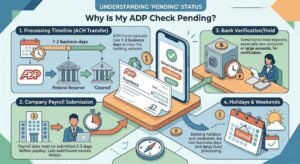
Why Is My ADP Check Pending? Why Is My ADP Check Pending? (2026 Guide) | ADP Salary Calculator Payroll Guide · Updated August 2026 Why

What Does OT Mean on an ADP Pay Stub? What Does “OT” Mean on an ADP Pay Stub? (2026 Guide) | ADP Salary Calculator Pay
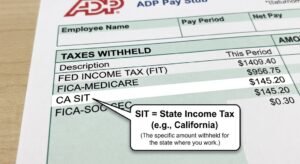
What Does SIT Mean on an ADP Pay Stub? What Does “SIT” Mean on an ADP Pay Stub? (2026 Guide) | ADP Salary Calculator Pay

Gusto vs Adp for Small Business ADP vs. Gusto Payroll for Small Business (2026 Comparison) | ADP Salary Calculator Payroll Software Comparison · Updated August
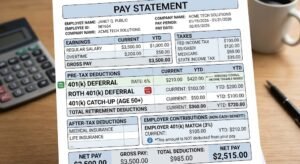
How 401(k) Contributions Appear on a Pay Stub How 401(k) Contributions Appear on a Pay Stub (2026 Guide) | ADP Salary Calculator Retirement & Payroll
Estimate your net pay with this easy-to-use salary paycheck calculator.
Note: adpsalarycalculator.com is not affiliated with ADP, Inc. | For informational purposes only.
Copyright © 2026. All Rights Reserved.