
What is FICA OASDI on My Paycheck?
What is FICA OASDI on My Paycheck What Is FICA OASDI on My Paycheck? (2026 Guide) | ADP Salary Calculator Pay Stub Glossary · Updated
These three terms get used interchangeably all the time — but they’re not the same thing, and mixing them up is exactly why W-2 numbers so often “don’t match” what people expect.
A paycheck, a pay stub, and a Form W-2 are all connected to your earnings — which is exactly why people mix them up. But they serve three different purposes: a paycheck is the actual payment for a specific work period, a pay stub is the itemized breakdown behind a single paycheck, and a W-2 is an annual summary of your total taxable wages and withholding for the entire year, filed once with the IRS.
This guide explains each one clearly, then walks through the single most common source of confusion: why your W-2 total almost never matches your final pay stub of the year. For a deep dive into a single pay stub’s contents, see our complete pay stub guide.
A paycheck is the physical check or direct deposit transfer your employer issues for a specific work period. It’s the actual transfer of funds — the money itself, not a document describing the money.
In casual conversation, people often say “paycheck” when they actually mean the pay stub attached to it — which is understandable, since the two arrive together, but they’re not the same thing.
A pay stub is the document — paper or digital — that shows the math behind a single paycheck. It’s not money itself; it’s the explanation of how your gross pay turned into your net pay for that period.
For a full section-by-section breakdown of everything on a pay stub, see our pay stub explainer.
Form W-2, the “Wage and Tax Statement,” is an official annual tax document your employer is required to send both to you and to the IRS (and applicable state/local agencies) early each year.
Employers must furnish W-2s to employees by January 31 of the following year. Think of it as a formal, IRS-facing summary — quite different from a pay stub’s informal, per-paycheck snapshot.
| Paycheck | Pay Stub | W-2 | |
|---|---|---|---|
| What it is | The actual payment | An itemized document | An official tax form |
| Covers | One pay period | One pay period (+ YTD totals) | The full calendar year |
| Issued by | Employer | Employer/payroll provider | Employer, also filed with IRS |
| Frequency | Every pay period | Every pay period | Once a year, by Jan 31 |
| Required by law? | Yes, wages must be paid | Varies by state | Yes, federally required |
| Can you file taxes with it? | No | No | Yes — required for filing |
Every tax season, this is one of the most common payroll questions: “Why doesn’t my W-2 match my last pay stub?” The short answer is that they’re measuring different things — your final pay stub shows gross year-to-date earnings, while your W-2’s Box 1 shows taxable wages after certain reductions.
| Reason for the Gap | Effect |
|---|---|
| Pre-tax retirement contributions (401(k), 403(b)) | Reduces Box 1 wages below gross pay |
| Pre-tax health insurance premiums | Reduces Box 1 (and often Box 3/5) wages |
| Pre-tax HSA/FSA contributions | Reduces Box 1 wages |
| Non-taxable reimbursements (e.g., mileage) | Appears on pay stub gross pay but excluded from W-2 wages |
Your salary/gross pay is your total earnings before deductions. Your W-2 shows taxable wages — gross pay minus pre-tax deductions. Unless you have zero pre-tax deductions, your W-2 will almost always be lower than your final pay stub’s gross pay figure.
Scenario: An employee earned $50,000 in gross wages for the year, contributed $5,000 to a traditional 401(k), and paid $2,000 in pre-tax health insurance premiums.
Nothing is wrong here — this $7,000 gap is expected and simply reflects pre-tax deductions doing exactly what they’re designed to do: lowering taxable income. Meanwhile, this same employee’s Social Security wages (Box 3) would typically be $48,000 (only the health premium is FICA-exempt in many plans; the 401(k) contribution generally is not exempt from FICA) — illustrating why even the boxes within the W-2 itself don’t always match each other.
Since the W-2 is the least-understood of the three documents, here’s what its most important boxes actually mean:
| Box | What It Shows |
|---|---|
| Box 1 | Total taxable wages, tips, and other compensation (after pre-tax deductions) |
| Box 2 | Federal income tax withheld for the year |
| Box 3 | Wages subject to Social Security tax (up to the annual wage base, $184,500 in 2026) |
| Box 4 | Social Security tax withheld (6.2% of Box 3) |
| Box 5 | Wages subject to Medicare tax (no cap, so often the highest wage figure on the form) |
| Box 6 | Medicare tax withheld (1.45% of Box 5, plus 0.9% above the Additional Medicare Tax threshold) |
| Box 12 | Coded compensation and benefit amounts (e.g., Code D for 401(k) deferrals, Code W for employer HSA contributions, Code DD for the cost of employer health coverage) |
| Box 13 | Checkboxes indicating retirement plan participation, third-party sick pay, or statutory employee status |
| Box 14 | Miscellaneous items your employer chooses to report (state disability tax, union dues, etc.) |
| Boxes 15–17 | State employer ID, state wages, and state income tax withheld |
| Boxes 18–20 | Local wages, local tax withheld, and the name of the locality |
Notice that Box 1, Box 3, and Box 5 can all show different wage figures on the same W-2 — that’s normal, not an error, since each box excludes a different set of pre-tax deductions.
| Situation | Use This Document |
|---|---|
| Filing your annual tax return | W-2 |
| Proving current income for an apartment application | Recent pay stub(s) |
| Verifying a specific paycheck was calculated correctly | Pay stub |
| Confirming a specific payment actually cleared your bank | Bank statement / paycheck deposit record |
| Applying for a mortgage (often wants both recent and historical income) | Recent pay stubs + 1–2 years of W-2s |
| Checking your annual retirement contribution total | W-2 Box 12 (Code D) or your final pay stub’s YTD line |
A W-2 lower than your stated salary is normal and expected if you have any pre-tax deductions — it’s not an error unless the gap doesn’t match your actual pre-tax contributions for the year.
Manually adding gross pay across pay stubs won’t match your W-2’s taxable wages, since it won’t account for pre-tax deductions the same way payroll systems do — and the IRS requires the official W-2 for filing regardless.
See how gross pay, pre-tax deductions, and taxes fit together with our free ADP Salary Calculator.
Try the Free Calculator →What is FICA OASDI on My Paycheck What Is FICA OASDI on My Paycheck? (2026 Guide) | ADP Salary Calculator Pay Stub Glossary · Updated
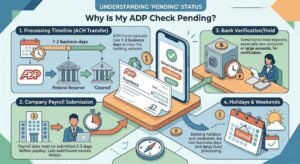
Why Is My ADP Check Pending? Why Is My ADP Check Pending? (2026 Guide) | ADP Salary Calculator Payroll Guide · Updated August 2026 Why

What Does OT Mean on an ADP Pay Stub? What Does “OT” Mean on an ADP Pay Stub? (2026 Guide) | ADP Salary Calculator Pay
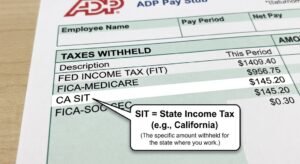
What Does SIT Mean on an ADP Pay Stub? What Does “SIT” Mean on an ADP Pay Stub? (2026 Guide) | ADP Salary Calculator Pay

Gusto vs Adp for Small Business ADP vs. Gusto Payroll for Small Business (2026 Comparison) | ADP Salary Calculator Payroll Software Comparison · Updated August
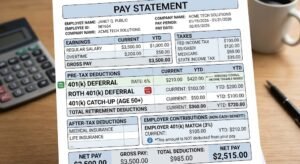
How 401(k) Contributions Appear on a Pay Stub How 401(k) Contributions Appear on a Pay Stub (2026 Guide) | ADP Salary Calculator Retirement & Payroll
Estimate your net pay with this easy-to-use salary paycheck calculator.
Note: adpsalarycalculator.com is not affiliated with ADP, Inc. | For informational purposes only.
Copyright © 2026. All Rights Reserved.