Understanding Your First US Paycheck on OPT (2026 Guide) | ADP Salary Calculator
International Student Payroll Guide · Updated August 2026
Understanding Your First US Paycheck on OPTWhy It Looks Different From a Typical American Paycheck
If you’re an F-1 student starting your first US job on OPT, your pay stub will look a little unusual — in a good way. Here’s exactly what’s different and why.
📅 August 2026⏱ 10 min read🌐 adpsalarycalculator.com
⚡ Quick Answers
Social Security & Medicare on OPT
Usually exempt (0%)
Federal income tax on OPT
Still applies, as normal
FICA exemption typically lasts
First 5 calendar years in the US
W-4 filing status box
Single/MFS, regardless of actual status
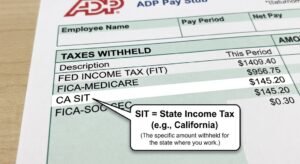
If this is your first US paycheck on Optional Practical Training (OPT), you might notice something your American classmates’ pay stubs don’t have: no Social Security or Medicare tax line at all. That’s not a payroll error — it’s a real tax exemption that applies to most F-1 students, and it’s one of several ways an OPT paycheck differs from a typical US employee’s.
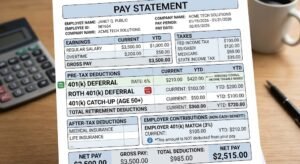
This guide walks through exactly what to expect on your first pay stub, why it’s structured differently, and what to double-check to make sure your employer has set things up correctly. For the general mechanics of reading a pay stub — gross pay, deductions, net pay — see our complete pay stub guide.
Most F-1 students working on OPT are exempt from FICA — Social Security (6.2%) and Medicare (1.45%), totaling 7.65% of wages — under a specific federal tax code provision, IRC Section 3121(b)(19). This applies as long as you remain classified as a nonresident alien for tax purposes.
What This Is Worth
On a $60,000 salary, the 7.65% FICA exemption is worth roughly $4,590 per year — about $176 extra per biweekly paycheck compared to a similarly paid resident employee.
This exemption also covers practical training authorized by USCIS — which includes both CPT and OPT — as long as you’re still a nonresident alien for tax purposes. It applies to F-1, J-1, M-1, and Q visa holders, not just F-1 students specifically.
2 Not Tax-Free
What You’re Still Taxed On
The FICA exemption is significant, but it doesn’t mean your OPT paycheck is tax-free. It’s easy to mix these up, so here’s the full picture:
Tax
Applies to OPT Wages?
Social Security (6.2%)
❌ Generally exempt
Medicare (1.45%)
❌ Generally exempt
Federal Income Tax
✅ Yes, withheld as normal
State Income Tax
✅ Yes, in states that have it
Local/City Tax
✅ Yes, where applicable
⚠️ “Exempt from FICA” ≠ “exempt from withholding”: Some OPT workers see a smaller-than-expected paycheck and assume payroll made an error, when in fact federal income tax is simply still being withheld correctly — only the FICA lines should read zero.
3 How Long It Lasts
The 5-Year Nonresident Rule
The FICA exemption isn’t permanent — it’s tied to your tax residency status, which is determined by the Substantial Presence Test. F-1 students are generally treated as “exempt individuals” for this test (a different meaning of “exempt” than the tax exemption itself) for their first 5 calendar years of physical presence in the US.
The IRS counts by calendar year (January 1–December 31), not by 12-month anniversary — arriving in November still counts as one full year
Once those 5 calendar years pass, you generally become a resident alien for tax purposes, even though your immigration status (F-1) hasn’t changed
Once you’re a resident alien for tax purposes, the FICA exemption ends and Social Security and Medicare will begin being withheld like any other employee
💡 Immigration status ≠ tax status: Being on F-1 or OPT doesn’t automatically make you a nonresident alien forever. Tax residency and immigration status are determined separately, which is why a 6th-year F-1 student can still be on valid OPT while no longer qualifying for the FICA exemption.
4 The W-4 Differences
Why Your W-4 Looks Different
Nonresident alien employees are required to follow special instructions (found in IRS Notice 1392) when completing Form W-4, which differ from the standard instructions most US employees follow:
Filing status: Check “Single or Married filing separately” in Step 1(c), regardless of your actual marital status
Step 3 (dependents): Generally cannot be used to claim the Child Tax Credit or Credit for Other Dependents, with limited treaty-based exceptions
Step 4(c) “Extra withholding”: Cannot write “Exempt,” even if you expect to owe no tax
Extra wage add-on: Employers are required to add a specific dollar amount to a nonresident employee’s wages, solely for the purpose of calculating how much income tax to withhold — this add-on doesn’t appear on your W-2 and doesn’t actually increase your tax liability, it just adjusts the withholding calculation itself
💡 Exception for students from India: Nonresident alien students and business apprentices from India are not subject to the extra wage add-on described above, due to the specific terms of the US-India tax treaty.
5 Getting an SSN
Getting Your Social Security Number
You’ll need a Social Security Number (SSN) to be paid through standard US payroll, even though you’re exempt from paying into Social Security itself. If you don’t already have one:
Confirm you have a valid job offer and your OPT Employment Authorization Document (EAD) in hand
Gather required documents: passport, I-94 record, Form I-20 endorsed for OPT, and your EAD card
Apply in person at a local Social Security Administration office
Processing typically takes a few weeks — some employers can begin payroll setup with a “pending SSN” placeholder in the meantime, though policies vary
6 State Tax
State Tax Still Applies
The FICA exemption is a federal rule — it has no bearing on state income tax. If you work in a state with income tax, it will be withheld from your paycheck the same way it is for any other employee. If you work in one of the nine states with no state income tax (including Texas, Florida, and Washington), you simply won’t see a state tax line at all — same as for any resident employee in that state.
💡 Comparing job offers: Since the FICA exemption applies everywhere in the US, the meaningful tax difference between job offers in different states for an OPT worker comes down to state income tax rates — not the FICA exemption, which is the same nationwide.
7 Real Example
Real Example: OPT Paycheck vs. a Typical W-2 Paycheck
Scenario: Two employees, both earning $30/hour and working a standard 80-hour biweekly pay period ($2,400 gross) in the same no-income-tax state. One is on OPT as a nonresident alien; the other is a US resident employee.
💰 OPT Employee (Nonresident, FICA-Exempt)
Gross Pay$2,400.00
Federal Income Tax−$264.00
Social Security$0.00 (exempt)
Medicare$0.00 (exempt)
Net Pay$2,136.00
💰 Resident Employee (Same Pay, Not FICA-Exempt)
Gross Pay$2,400.00
Federal Income Tax−$264.00
Social Security (6.2%)−$148.80
Medicare (1.45%)−$34.80
Net Pay$1,952.40
Same gross pay, same federal withholding estimate — but the OPT employee takes home $183.60 more per paycheck simply due to the FICA exemption, in this simplified example.
8 STEM OPT
STEM OPT Extension
If you extend your OPT under the STEM OPT extension (an additional 24 months for eligible STEM degree holders), the same underlying rule applies: your FICA exemption continues as long as you remain a nonresident alien for tax purposes — not simply because you’re on STEM OPT.
For many students, this means the FICA exemption ends partway through their STEM OPT period once they cross the 5-calendar-year threshold described above — it’s tied to your time in the US, not to which stage of OPT you’re on.
9 Tax Treaties
Tax Treaties: A Possible Extra Benefit
Depending on your country of citizenship, the US may have a tax treaty that offers additional benefits — such as a limited exemption from federal income tax on a portion of wages, or in some cases the ability to claim the standard deduction as a nonresident (normally unavailable to nonresident aliens, with the India treaty as the notable exception).
Treaty benefits vary significantly by country and aren’t automatic — you generally need to file Form 8233 with your employer to claim a withholding exemption based on a treaty
Not every country has a relevant treaty provision for students or trainees
A tax professional experienced with nonresident returns, or your university’s international student office, can help determine whether a treaty applies to you
10 Annual Filing
What You’ll File Each Spring
Your pay stub and eventual W-2 feed directly into your annual tax filing obligations as an international student:
Form 8843 — required for all F-1/J-1 nonresident students, even those with no income, to document your exempt individual status for the Substantial Presence Test
Form 1040-NR — the nonresident income tax return, required if you have US-source taxable wages, want to claim a refund, or need to report a treaty position
Once you become a resident alien for tax purposes (after your 5-year nonresident window), you’ll generally file Form 1040 like other US resident taxpayers instead
⚠️ Common mistake: Some nonresident students mistakenly use resident tax software or file Form 1040 while still a nonresident alien, which can lead to claiming credits or deductions they’re not eligible for. Look specifically for software or preparers experienced with Form 1040-NR.
11 Common Mistakes
Common Mistakes and Misconceptions
MISTAKEAssuming OPT means no taxes at all
FIX
Only FICA (Social Security and Medicare) is generally exempt. Federal and state income tax still apply and should appear on your pay stub as normal.
MISTAKENot noticing FICA being withheld in error
FIX
If Social Security and Medicare are being withheld from your OPT paycheck and you’re still within your nonresident window, raise it with payroll or HR promptly — some employers, especially those unfamiliar with nonresident rules, withhold FICA incorrectly by default.
MISTAKEFiling the wrong tax return in the spring
FIX
Nonresident aliens generally can’t use standard resident tax software or file Form 1040 — Form 1040-NR (plus Form 8843) is typically required instead, at least until you become a resident alien for tax purposes.
MISTAKEAssuming the FICA exemption lasts as long as OPT does
FIX
The exemption is tied to your nonresident tax status (generally 5 calendar years), not to your OPT or STEM OPT authorization period, which can last longer than your nonresident window.
12 Quick Checklist
Checklist for Your First Pay Stub
Confirm Social Security and Medicare show $0.00 (assuming you’re within your nonresident window)
Confirm federal income tax is being withheld as expected
Confirm state income tax is applied correctly for the state you’re working in
Double-check your name and SSN are correctly entered
Verify your hours and pay rate match your offer letter
Save every pay stub — you’ll want them for tax filing and as income verification for things like apartment leases
Frequently Asked Questions
First US Paycheck on OPT — FAQs
Why is there no Social Security or Medicare tax on my OPT paycheck?
Most F-1 students working on OPT are exempt from FICA (Social Security and Medicare) tax under IRC Section 3121(b)(19), as long as they remain classified as a nonresident alien for tax purposes. This exemption generally applies for the first 5 calendar years of physical presence in the US as an F-1, J-1, M-1, or Q visa holder.
Does the FICA exemption mean my OPT paycheck is tax-free?
No. Federal income tax, and state income tax where applicable, still apply to OPT wages. Only the 7.65% Social Security and Medicare portion is exempt — federal and state income tax withholding continue as normal.
Why does my W-4 look different as an international student?
The IRS requires nonresident alien employees to follow special W-4 instructions in Notice 1392: checking “Single or Married filing separately” regardless of actual marital status, not claiming the Child Tax Credit in Step 3 unless a specific exception applies, and not writing “Exempt” in Step 4(c). Employers also add a set dollar amount to nonresident wages solely for calculating withholding, which does not appear on the W-2 or increase actual tax liability.
How long does the FICA exemption last on OPT?
The exemption generally lasts through your first 5 calendar years of physical presence in the US as an F-1 student, counted from January 1 of the year you first arrived, regardless of the actual month you entered. After that, most F-1 holders become resident aliens for tax purposes under the Substantial Presence Test and are no longer exempt from FICA, including during a STEM OPT extension.
Do I need a Social Security Number to get paid on OPT?
Yes. You need a Social Security Number (SSN) to be paid through standard US payroll. If you don’t already have one, you can apply once you have a valid job offer and OPT authorization (an unexpired EAD card), typically at a local Social Security Administration office.
What should I do if my employer is withholding FICA from my OPT paycheck?
Raise it with your payroll or HR department as soon as you notice it, since some employers default to standard withholding without accounting for nonresident status. If FICA was withheld in error in a prior period, a refund can generally be requested from the employer first, and if unresolved, through IRS Forms 843 and 8316.
Which tax return should I file as an OPT worker?
Most F-1 students on OPT who are still nonresident aliens for tax purposes file Form 1040-NR (if they have taxable wages or a refund claim) along with Form 8843. Once you become a resident alien for tax purposes after your nonresident window ends, you’ll generally file Form 1040 instead, like other US residents.
Estimate Your OPT Take-Home Pay
See how your gross pay translates to net pay with our free ADP Salary Calculator.
Gusto vs Adp for Small Business ADP vs. Gusto Payroll for Small Business (2026 Comparison) | ADP Salary Calculator Payroll Software Comparison · Updated August