
What is FICA OASDI on My Paycheck?
What is FICA OASDI on My Paycheck What Is FICA OASDI on My Paycheck? (2026 Guide) | ADP Salary Calculator Pay Stub Glossary · Updated
You see “YTD” on every pay stub — but what does it actually mean, and why does it matter? This guide breaks it down completely with real examples.
Every time you look at your paycheck or pay stub, you’ll see the letters YTD next to almost every number — your gross earnings, your federal tax, your Social Security, your 401(k) contribution. But what exactly does it mean?
YTD stands for Year-to-Date. It is simply a running total that adds up everything from the first day of the year to today. Think of it like an odometer — it keeps counting from zero at the start of every January and doesn’t reset until the new year begins.
In this guide, we explain exactly what YTD means for each section of your paycheck, show you real-number examples, and explain why it’s one of the most useful numbers on your entire pay stub. If you’re new to reading paychecks, start with our complete guide to reading your ADP pay stub first.
YTD — short for Year-to-Date — is a running total that accumulates from the first day of the current calendar year (January 1) through the date of your most recent paycheck.
Every time you receive a paycheck, the amounts from that pay period are added to the YTD column. The YTD column grows with every paycheck and represents your total activity for the year so far — not just one pay period.
YTD = The sum of all pay periods from Jan 1 through your last paycheck
YTD figures appear for every line item on your pay stub: gross earnings, each type of tax, each benefit deduction, and your net pay. Each one has its own separate YTD running total. You can read more about how payroll periods work on the IRS Employment Taxes page.
On most ADP pay stubs, the layout has two main columns side by side:
| Column | What It Shows |
|---|---|
| Current Period | The amount for this paycheck only (e.g., taxes withheld this week) |
| YTD | The cumulative running total since January 1 of this year |
These two columns appear for every line on your pay stub — earnings, taxes, and deductions all have both a current-period amount and a YTD total next to each other. For a full visual breakdown of each section, see our ADP pay stub guide with labeled sections.
Your YTD Gross Earnings is the total amount you have earned from your employer before any taxes or deductions — from January 1 through your last paycheck.
This number includes every type of earnings you’ve received this year:
Biweekly gross pay of $2,500 × 12 pay periods = YTD Gross of $30,000 by mid-year
YTD Gross is the number most commonly requested by lenders, landlords, and financial institutions when they ask to verify your income. It is also what appears in Box 1 of your W-2 form at year-end (adjusted for pre-tax deductions).
Every tax on your pay stub has its own YTD column, showing how much of that specific tax has been withheld in total this year.
| Tax Line | What the YTD Shows | 2026 Annual Limit |
|---|---|---|
| Federal Income Tax | Total federal tax withheld so far this year | No hard limit — based on bracket |
| Social Security (OASDI) | Total SS tax withheld — should stop at wage base | 6.2% up to $174,900 wages |
| Medicare (MED) | Total Medicare tax withheld this year | 1.45% on all wages (no cap) |
| State Income Tax | Total state tax withheld this year | Varies by state |
| Local / City Tax | Total local tax withheld this year | Varies by city |
Your benefits and voluntary deductions also have their own YTD columns, tracking how much has been deducted in total this year.
| Deduction | Why YTD Tracking Matters | 2026 Annual Limit |
|---|---|---|
| 401(k) / 403(b) | Must not exceed IRS annual contribution limit | $23,500 ($31,000 if 50+) |
| Health Insurance | Verify correct premiums are being deducted | No IRS limit |
| HSA | Contributions must stay within IRS annual cap | $4,300 single / $8,550 family |
| FSA | Use-it-or-lose-it — track spending pace | $3,300 per year |
| Commuter Benefits | Confirm monthly limits are being respected | $315/month transit + $315/month parking |
Your YTD Net Pay is the total amount actually deposited into your bank account (or paid by check) from January 1 through your most recent payday.
YTD Net Pay is useful for personal budgeting — it tells you exactly how much money has actually landed in your hands this year, which you can compare against your spending, savings goals, or emergency fund targets. Use our ADP Salary Calculator to instantly estimate your full-year net pay based on your current paycheck.
Let’s say Sarah earns $60,000/year and is paid biweekly (26 pay periods). By the end of pay period 13 — exactly halfway through the year — here’s what her pay stub YTD columns would show:
By mid-year, Sarah has taken home $18,510 out of her $30,000 gross — about 61.7% of gross earnings. At year-end, her YTD Net Pay will be approximately $37,020 (assuming no changes in deductions or hours).
YTD isn’t just a number on a form. It has concrete, practical uses in your financial life:
When you apply for a mortgage, car loan, personal loan, or apartment, lenders and landlords will ask for proof of income. Your YTD gross earnings (shown on recent pay stubs) is the most commonly requested document to verify your current annual income. Our net pay calculator can help you quickly compute the figures lenders need.
By reviewing your YTD columns regularly, you can catch mistakes before they compound. A wrong pay rate applied for 10 pay periods is a much bigger problem than catching it after one. YTD makes cumulative errors visible quickly.
Your YTD 401(k) column tells you exactly how much you’ve contributed toward the IRS annual limit. If you want to maximize your contribution by year-end, you can use YTD to calculate how much more to contribute per paycheck.
Your final pay stub YTD figures should closely match your W-2 form. If your W-2 gross income (Box 1) differs significantly from your final YTD gross, contact your payroll department — it could indicate an error that affects your tax return.
Comparing your YTD federal income tax withheld against an estimated tax liability helps you avoid underpaying (and owing penalties) or overpaying (and giving the IRS an interest-free loan).
Your YTD net pay is essentially your total cash inflow for the year. Comparing it against your actual spending gives you a clear picture of whether you’re living within your means or overspending.
Your pay stub’s YTD columns are one of the most powerful free tax planning tools available to you — and most people completely ignore them.
Divide your YTD federal income tax withheld by your YTD gross earnings to get your effective withholding rate so far. Compare that to your expected tax bracket for the year.
If your expected marginal tax rate is 22% but your withholding rate is only 16%, you’re likely under-withheld and may owe taxes in April. Submit a new W-4 to increase withholding for the remaining pay periods. The IRS Tax Withholding Estimator is a free tool that helps you figure out exactly how much to withhold.
| When YTD Gross Hits… | What Happens |
|---|---|
| $174,900 | Social Security tax (6.2%) stops being withheld for the rest of the year |
| $200,000 | Additional Medicare Tax (0.9%) begins — total Medicare becomes 2.35% |
| $23,500 (401k) | Employee 401(k) contributions must stop — IRS annual employee limit reached |
| $4,300 (HSA single) | HSA contributions must stop — IRS annual limit reached for individual coverage |
YTD errors are less common than single pay period errors, but they do happen — and because YTD accumulates over time, an early mistake can compound into a large discrepancy by year-end. Review our ADP pay stub guide to understand what each line should show, making errors easier to spot.
YTD is sometimes confused with other similar financial acronyms. Here’s a quick comparison:
| Term | Stands For | Time Period Covered |
|---|---|---|
| YTD | Year-to-Date | Jan 1 of current year → today |
| MTD | Month-to-Date | 1st of current month → today |
| QTD | Quarter-to-Date | Start of current quarter → today |
| LTM / TTM | Last Twelve Months / Trailing Twelve Months | Rolling 12-month window → today |
| ITD | Inception-to-Date | Start of employment/account → today |
On pay stubs, you will almost always see YTD. MTD and QTD appear more commonly in business financial reporting and accounting software.
Use our free ADP Salary Calculator to estimate your full-year gross, net pay, and tax totals based on your current paycheck — so you know exactly where you’ll land by December.
Try the Free Calculator →What is FICA OASDI on My Paycheck What Is FICA OASDI on My Paycheck? (2026 Guide) | ADP Salary Calculator Pay Stub Glossary · Updated
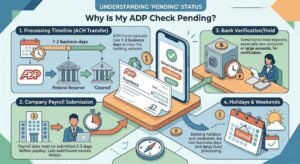
Why Is My ADP Check Pending? Why Is My ADP Check Pending? (2026 Guide) | ADP Salary Calculator Payroll Guide · Updated August 2026 Why

What Does OT Mean on an ADP Pay Stub? What Does “OT” Mean on an ADP Pay Stub? (2026 Guide) | ADP Salary Calculator Pay
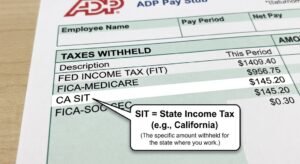
What Does SIT Mean on an ADP Pay Stub? What Does “SIT” Mean on an ADP Pay Stub? (2026 Guide) | ADP Salary Calculator Pay

Gusto vs Adp for Small Business ADP vs. Gusto Payroll for Small Business (2026 Comparison) | ADP Salary Calculator Payroll Software Comparison · Updated August
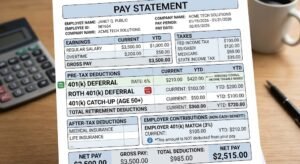
How 401(k) Contributions Appear on a Pay Stub How 401(k) Contributions Appear on a Pay Stub (2026 Guide) | ADP Salary Calculator Retirement & Payroll
Estimate your net pay with this easy-to-use salary paycheck calculator.
Note: adpsalarycalculator.com is not affiliated with ADP, Inc. | For informational purposes only.
Copyright © 2026. All Rights Reserved.