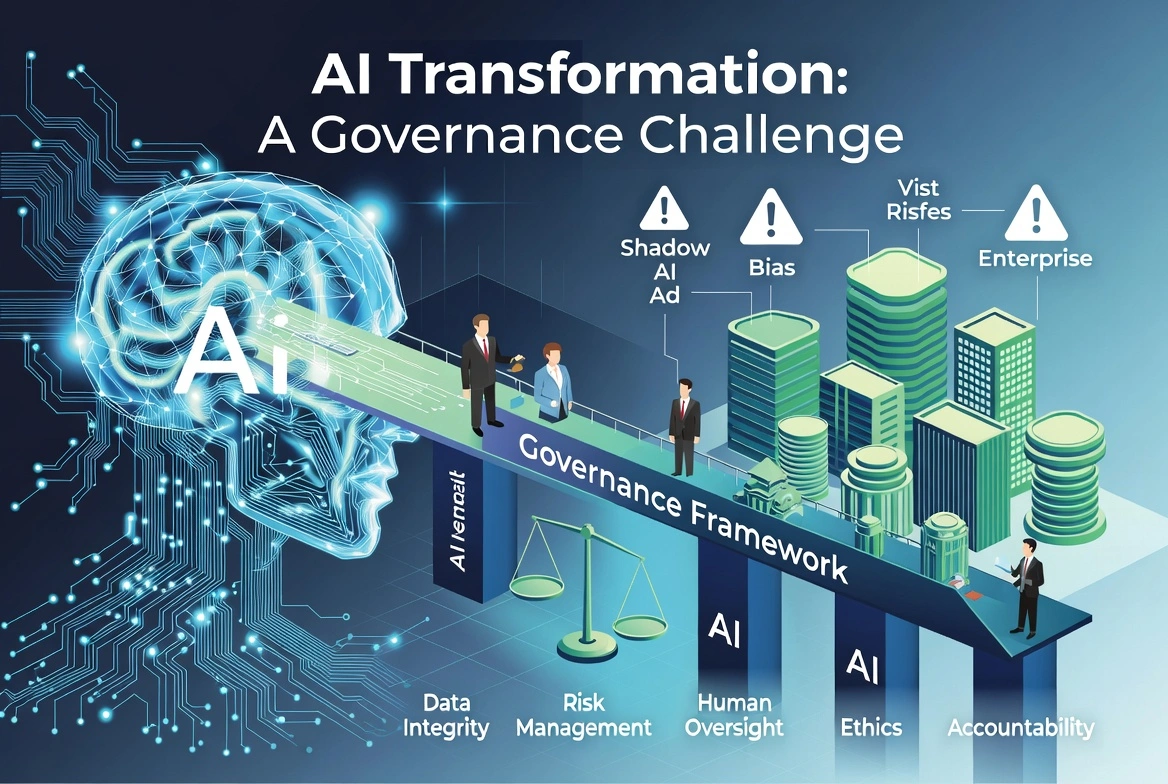
AI initiatives frequently stall after promising pilots. Models perform well in controlled tests, yet fail to scale, deliver ROI, or avoid risks at enterprise level. The core issue is rarely the algorithms, data, or talent—it is governance. Without structured oversight, accountability, policies, and processes, even the best AI becomes a source of inefficiency, compliance violations, reputational damage, and lost value.
Why Governance Determines Success or Failure
Enterprises pour billions into AI, yet statistics reveal the gap: a tiny percentage achieve true maturity, many deployments fail to deliver ROI, and shadow AI proliferates unchecked. Deployment alone is not transformation—governance is what turns experiments into reliable, scalable capabilities.
AI differs fundamentally from traditional IT:
- Outputs are probabilistic and evolve with new data.
- Accountability blurs easily (“Who approved this decision?”).
- Risks compound: bias, data leakage, model drift, regulatory non-compliance.
- Shadow AI (unauthorized tools) creates invisible exposures.
Governance bridges this by embedding controls from design through deployment and ongoing monitoring, not as post-hoc audits.
Core Pillars of Effective AI Governance
A robust framework rests on interconnected pillars:
- Data Governance and Integrity Ensure high-quality, traceable, secure data with proper lineage, access controls, and stewardship. Biased or poor data leads to unreliable or harmful outputs.
- Model Lifecycle Management Cover development, validation, versioning, monitoring for drift, and retraining. Include clear approval flows and performance tracking.
- Risk, Compliance, and Security Embed risk assessments, map to regulations (e.g., EU AI Act high-risk requirements, data protection laws), and address AI-specific threats like poisoning or inversion. Define non-negotiables: human oversight for high-stakes decisions, logging, and incident response.
- Ethics, Transparency, and Explainability Prevent bias, enable auditability, and ensure decisions can be explained. Regular audits and fairness checks build trust.
- Organization, Roles, and Accountability Assign clear owners: business owner (outcomes), data owner, model owner. Establish cross-functional AI councils or committees with real authority, executive sponsorship (ideally COO/C-level), and decision rights mapped on one page.
Additional enablers:
- Human-in-the-Loop (HITL): Mandatory review for sensitive or high-risk outputs.
- Tiered Use Cases: Fast-track low-risk (e.g., internal productivity) vs. rigorous review for customer-facing or regulated ones.
- Approved Patterns Library: Reuse secure, governed implementations (e.g., RAG with guardrails) to reduce reinvention.
Common Failure Points (and How to Avoid Them)
- No executive sponsorship with authority.
- Siloed teams and fragmented practices.
- Policies exist on paper but lack enforcement or employee awareness.
- No continuous monitoring → surprises in production.
- Governance treated as audit-time retrofit instead of design-time requirement.
- Shadow AI due to lack of sanctioned tools or slow processes.
Real-world examples illustrate the costs: chatbots creating liability without verified retrieval and oversight; drive-thru systems failing at scale due to missing monitoring; POCs abandoned for lack of adoption frameworks.
Practical Implementation Roadmap
Phase 1: Audit — Inventory all AI use cases, assess current risks, maturity, and gaps.
Phase 2: Classify — Tier use cases by risk and impact.
Phase 3: Define Ownership — Assign roles, decision rights, and escalation paths. Secure C-level sponsor.
Phase 4: Build Policies and Processes — Create lightweight intake forms, approval flows with SLAs, standards, and monitoring. Integrate into tools and job descriptions.
Phase 5: Pilot, Scale, Measure — Start small, iterate, track metrics like approval time, production use cases, incidents, and business value. Publish wins to build momentum.
Treat governance as a product, not paperwork: make it fast for safe use cases, provide approved tools to reduce shadow AI, and measure its enabling impact.
Regulatory Reality and Global Challenges
Regulations like the EU AI Act (with prohibitions, high-risk obligations, and heavy fines) demand inventories, risk management, human oversight, and documentation. Other regions vary (sectoral in the US, etc.), creating a “splinternet” for global firms. Strong governance ensures compliance becomes a competitive advantage, not a burden.
Standards like ISO/IEC 42001 emphasize ethics-by-design and management systems.
The Business Case: Governance as an Accelerator
Well-governed AI reduces risks, prevents redundant spending, enables integration, builds trust, and speeds safe scaling. It shifts culture from “Department of No” to enabler—teams innovate confidently within guardrails. Organizations with mature frameworks achieve higher adoption, better ROI, and resilience.
Conclusion:
AI transformation fails or succeeds based on operating models, accountability, and controls not just technology. Leaders who treat governance as foundational will turn pilots into enterprise value, navigate regulation, and build sustainable advantage.
Start today: Draft a one-page decision rights map, propose tiers, run a cross-functional workshop, and secure executive backing. The tech is ready the question is whether your organization is governed to use it responsibly and effectively.
This integrated approach draws from proven practices across enterprise experiences and turns governance into your strongest AI enabler.