Pay Stub vs Paycheck vs W-2: What’s the Difference?
Pay Stub vs Paycheck vs W-2: What’s the Difference? Pay Stub vs. Paycheck vs. W-2: What’s the Difference? (2026) | ADP Salary Calculator Payroll Glossary
Most companies have already made the switch — but is a digital pay stub really an upgrade, or just a cost-saving move for your employer? Here’s an honest comparison.
A decade ago, a paper pay stub tucked into your check or mailed to your home was the default. Today, most employees log into a portal like ADP’s employee self-service site to view and download their pay stubs instead. That shift wasn’t just about employer convenience — it also intersects with real state laws about what employers are required to provide.
This guide compares digital and paper pay stubs across the factors that actually matter: legal requirements, security, convenience, recordkeeping, and cost — so you can understand not just which one your employer uses, but whether you have any say in it. For a full breakdown of what’s actually printed on a stub, see our guide to reading your ADP pay stub.
There’s no federal law that requires employers to provide pay stubs at all. The Fair Labor Standards Act (FLSA) requires employers to keep payroll records, but it doesn’t require those records be shared with employees in stub form.
What actually governs digital versus paper comes down to state law — and it varies significantly:
States that regulate pay stubs generally fall into one of three approaches:
| Model | How It Works | Example States |
|---|---|---|
| Opt-out (paper default) | Employers must provide paper unless the employee affirmatively consents in writing to electronic delivery | Delaware, Minnesota (some states are shifting away from this model) |
| Consent-free electronic | Employers may provide electronic-only stubs by default, but employees can request paper copies at no cost | Washington, Colorado, Oregon (as of January 2026) |
| Access/print | Stubs must be accessible and printable by the employee, in either paper or electronic form | California, Texas, North Carolina |
Both formats carry real but different risks:
| Risk | Paper | Digital |
|---|---|---|
| Loss in the mail | Possible | Not applicable |
| Theft from a mailbox or desk | Possible | Not applicable |
| Improper disposal (trash, recycling) exposing SSN/bank details | Common risk if not shredded | Not applicable |
| Account compromise (weak password, phishing) | Not applicable | Possible |
| Payroll portal data breach | Not applicable | Possible, though employer/vendor-managed with security controls |
On balance, a properly secured digital portal (encrypted connection, individual login, multi-factor authentication where offered) is generally considered more secure than paper, which depends heavily on the employee’s own handling and disposal habits. That said, digital security is only as strong as the employee’s own password hygiene and the employer’s platform security.
Pay stubs matter well beyond payday — they’re commonly requested as proof of income for loan applications, apartment rentals, and government benefit applications, and they help you verify your withholdings and deductions match your expectations at tax time.
It’s worth being honest about why many employers have shifted to digital-first: it’s meaningfully cheaper for them. Printing, envelopes, postage, and administrative time for physical distribution add up, especially for larger companies. Digital delivery removes nearly all of that overhead.
Digital delivery doesn’t cost employees anything directly, and in states with a “request paper at no cost” right, employees can typically still get a physical copy without a fee.
In other words, the cost savings mostly benefit employers — but that doesn’t necessarily make digital delivery worse for employees, since (as covered above) it also offers real convenience and security advantages when implemented well.
Beyond cost, the reduction in paper, ink, and mail transportation from digital pay stubs represents a genuine environmental benefit at scale — particularly for large employers issuing thousands of pay stubs per pay period. For an individual employee, the personal environmental impact of choosing one format over the other is small, but it does contribute to the case many employers make for going digital-first as a matter of sustainability policy.
Digital-first delivery isn’t equally convenient for every employee. Worth considering:
This is part of why many states preserve a right to request paper copies even as electronic delivery becomes the default — it’s meant to prevent a digital-first policy from effectively excluding employees who can’t easily use it.
| Factor | Digital | Paper |
|---|---|---|
| Security (if well-managed) | Generally stronger | Depends on handling |
| Convenience for most users | Generally stronger | Depends on tech comfort |
| Long-term recordkeeping | Generally stronger | Requires physical storage |
| Accessibility without internet/tech | Weaker | Generally stronger |
| Employer cost | Lower | Higher |
| Environmental impact | Lower | Higher |
For most employees with reliable internet and smartphone access, digital pay stubs offer real advantages in security, convenience, and recordkeeping. For employees without consistent tech access, or who simply prefer a physical record, paper remains a legitimate and often legally protected option depending on the state.
In practice, many employers don’t force an all-or-nothing choice. A common setup looks like:
This approach captures most of digital delivery’s cost and efficiency benefits for the employer while preserving paper access for employees who want or need it — and it satisfies the legal requirements in most states regardless of which model applies.
Check your state’s pay stub law — several states preserve a right to request paper copies at no cost even under an electronic-first policy. Ask your HR or payroll department directly; many employers will accommodate the request even where it isn’t strictly mandated.
Ask whether your employer’s payroll provider (such as ADP) offers an employee self-service portal you can opt into, even if paper remains the company default.
Search your state’s Department of Labor website for “wage statement” or “pay stub” requirements, since rules and penalties vary and change from year to year.
Whichever format you receive, use our free ADP Salary Calculator to check that your gross pay, deductions, and net pay all add up correctly.
Try the Free Calculator →Pay Stub vs Paycheck vs W-2: What’s the Difference? Pay Stub vs. Paycheck vs. W-2: What’s the Difference? (2026) | ADP Salary Calculator Payroll Glossary
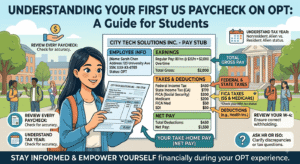
Understanding Your First US Paycheck on OPT Understanding Your First US Paycheck on OPT (2026 Guide) | ADP Salary Calculator International Student Payroll Guide ·
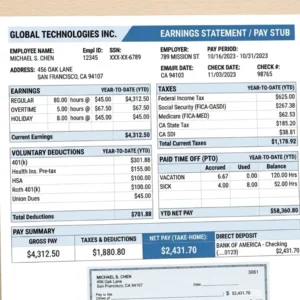
Understanding Your First US Paycheck on OPT Pay Stub Explained: Every Box and Line Item Decoded (2026) | ADP Salary Calculator Payroll Guide · Updated
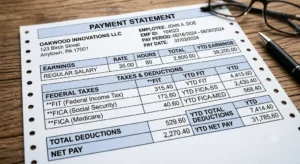
What Does “FIT”, “FICA”, and “YTD” Mean on a Pay Stub? What Does “FIT,” “FICA,” and “YTD” Mean on a Pay Stub? (2026) | ADP
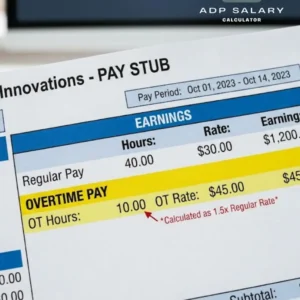
Understanding Overtime Pay on a Pay Stub Understanding Overtime Pay on a Pay Stub (2026 Guide) | ADP Salary Calculator Payroll Guide · Updated July
ADP Payroll Deductions Explained — What Each Line Means ADP Payroll Deductions Explained — What Each Line Means (2026) | ADP Salary Calculator Payroll Guide
Estimate your net pay with this easy-to-use salary paycheck calculator.
Copyright © 2026. All Rights Reserved.