
What is FICA OASDI on My Paycheck?
What is FICA OASDI on My Paycheck What Is FICA OASDI on My Paycheck? (2026 Guide) | ADP Salary Calculator Pay Stub Glossary · Updated
Every employer in the US must pay Federal Unemployment Tax (FUTA). This guide shows you exactly how to calculate it, claim your SUTA credit, and stay compliant with IRS rules.
If you’re an employer, payroll manager, or small business owner, understanding Federal Unemployment Tax (FUTA) is essential. Unlike Social Security and Medicare taxes — which are split between employer and employee — FUTA is paid 100% by the employer.
The good news: FUTA only applies to the first $7,000 of each employee’s wages per year, and most employers qualify for a 5.4% tax credit that drops the effective rate from 6% down to just 0.6%. That means the maximum FUTA tax per employee is usually only $42 per year.
This guide walks you through every step of calculating FUTA tax — from identifying taxable wages to claiming your SUTA credit and filing Form 940. For a full overview of all payroll taxes, see our guide to reading your ADP pay stub.
FUTA stands for the Federal Unemployment Tax Act. It is a federal payroll tax that employers must pay to fund unemployment insurance benefits — the payments that eligible workers receive when they lose their jobs through no fault of their own.
FUTA works alongside state unemployment programs. When someone files for unemployment, their benefits are funded through a combination of federal FUTA funds and state SUTA (State Unemployment Tax Act) funds.
For most employers, FUTA costs just $42 per employee per year ($7,000 × 0.6%). It is one of the smallest payroll tax obligations you’ll have.
There are two FUTA rates you need to know — the gross rate and the net rate after the SUTA credit:
| Rate Type | Rate | When It Applies |
|---|---|---|
| Gross FUTA Rate | 6.0% | Before any credits — applied to first $7,000 of wages |
| SUTA Credit | −5.4% | For employers who pay SUTA taxes fully and on time |
| Net FUTA Rate | 0.6% | Effective rate for most qualifying employers |
| Credit Reduction Rate | 0.6%–1.8%+ | For states that borrowed federal funds and haven’t repaid |
FUTA tax only applies to the first $7,000 of each employee’s gross wages during a calendar year. Once an employee’s cumulative wages for the year exceed $7,000, you stop paying FUTA on that employee — for the rest of the year.
$7,000 per employee per calendar year — unchanged since 1983
This $7,000 federal wage base has not changed in over 40 years. Many states, however, have much higher SUTA wage bases — some as high as $60,000+ per employee.
The biggest FUTA savings opportunity is the 5.4% SUTA credit. Here’s how it works:
If you pay your state unemployment taxes (SUTA) on time and in full, the IRS allows you to credit up to 5.4% against your 6% gross FUTA rate — reducing your net FUTA rate to just 0.6%.
Some states borrow money from the federal government when their unemployment funds run low. If a state hasn’t repaid those federal loans after two years, it becomes a credit reduction state. Employers in those states lose part of their 5.4% SUTA credit, increasing their effective FUTA rate.
Calculating FUTA tax is straightforward. Follow these four steps for each employee:
Add up the employee’s gross wages for the year. FUTA only applies to the first $7,000. If the employee has earned more than $7,000 this year, their FUTA taxable wages are capped at $7,000.
Let’s walk through three employees with different salary levels to see exactly how FUTA is calculated in practice.
For a business with multiple employees, you calculate FUTA separately for each employee and then total it up. Here’s an example with a small business that has 5 employees:
| Employee | Annual Wages | FUTA Taxable Wages | Net FUTA (0.6%) |
|---|---|---|---|
| Sarah | $72,000 | $7,000 | $42.00 |
| James | $45,000 | $7,000 | $42.00 |
| Maria | $28,000 | $7,000 | $42.00 |
| Tom | $5,500 | $5,500 | $33.00 |
| Lisa | $3,200 | $3,200 | $19.20 |
For employers using ADP payroll, FUTA calculations are handled automatically each payroll run. You can use our ADP Salary Calculator to quickly estimate payroll tax costs per employee.
FUTA and SUTA both fund unemployment benefits, but they operate at different levels with different rules:
| Feature | FUTA (Federal) | SUTA (State) |
|---|---|---|
| Administered by | IRS (federal) | State workforce agency |
| Tax rate | 6% gross / 0.6% net | Varies by state & employer (0.1%–10%+) |
| Wage base | $7,000 (federal, fixed) | $7,000–$65,400+ (varies by state) |
| Who pays | Employer only | Employer (some states also charge employees) |
| Rate variation | Fixed rate for all employers | Experience-rated — varies by layoff history |
| Filed on | IRS Form 940 | State-specific quarterly form |
| Due date | January 31 annually | Quarterly (varies by state) |
Not all workers or employers are subject to FUTA. Here are the main exemptions:
Every employer subject to FUTA must file IRS Form 940 — the Employer’s Annual Federal Unemployment (FUTA) Tax Return — once a year.
| Detail | Information |
|---|---|
| Form name | Form 940 — Employer’s Annual Federal Unemployment Tax Return |
| Due date | January 31 of the following year (e.g., Jan 31, 2027 for 2026 FUTA) |
| Extended deadline | February 10 if all FUTA deposits were made on time during the year |
| Filing method | Online via IRS e-file (recommended) or paper mail |
| Payment | Any balance due paid with filing (if under $500 for the year) |
FUTA taxes are deposited quarterly — but only when your cumulative FUTA liability exceeds $500 in a quarter. Here’s how it works:
| Quarter | Wages Paid | Deposit Due Date |
|---|---|---|
| Q1 (Jan–Mar) | Jan 1 – Mar 31 | April 30 |
| Q2 (Apr–Jun) | Apr 1 – Jun 30 | July 31 |
| Q3 (Jul–Sep) | Jul 1 – Sep 30 | October 31 |
| Q4 (Oct–Dec) | Oct 1 – Dec 31 | January 31 |
| Item | 2026 Details |
|---|---|
| Gross FUTA Rate | 6.0% of first $7,000 per employee |
| Max SUTA Credit | 5.4% (if SUTA paid on time, non-credit-reduction state) |
| Net FUTA Rate | 0.6% (after full credit) |
| FUTA Wage Base | $7,000 per employee per year |
| Max FUTA per Employee | $42.00 (if qualifying for full credit) |
| Max Gross FUTA per Employee | $420.00 (without credit) |
| Deposit Threshold | $500 per quarter |
| Deposit Method | EFTPS (electronic only) |
| Annual Return | Form 940 — due January 31, 2027 |
| Who Pays | Employer only — never deducted from employees |
Understanding payroll taxes is only part of the picture. Use our free ADP Salary Calculator to estimate your employees’ net pay, see the full tax breakdown, and plan your payroll budget with confidence.
Try the Free Calculator →What is FICA OASDI on My Paycheck What Is FICA OASDI on My Paycheck? (2026 Guide) | ADP Salary Calculator Pay Stub Glossary · Updated

Why Is My ADP Check Pending? Why Is My ADP Check Pending? (2026 Guide) | ADP Salary Calculator Payroll Guide · Updated August 2026 Why

What Does OT Mean on an ADP Pay Stub? What Does “OT” Mean on an ADP Pay Stub? (2026 Guide) | ADP Salary Calculator Pay
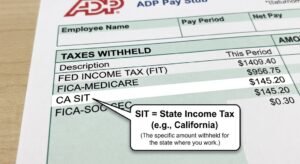
What Does SIT Mean on an ADP Pay Stub? What Does “SIT” Mean on an ADP Pay Stub? (2026 Guide) | ADP Salary Calculator Pay

Gusto vs Adp for Small Business ADP vs. Gusto Payroll for Small Business (2026 Comparison) | ADP Salary Calculator Payroll Software Comparison · Updated August

How 401(k) Contributions Appear on a Pay Stub How 401(k) Contributions Appear on a Pay Stub (2026 Guide) | ADP Salary Calculator Retirement & Payroll
Estimate your net pay with this easy-to-use salary paycheck calculator.
Note: adpsalarycalculator.com is not affiliated with ADP, Inc. | For informational purposes only.
Copyright © 2026. All Rights Reserved.